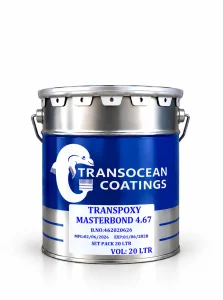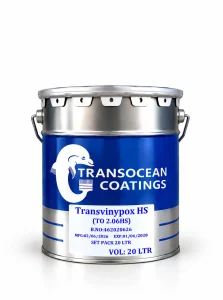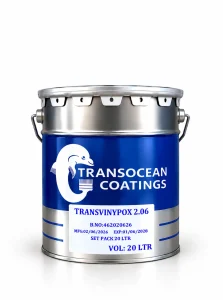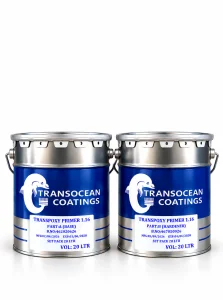


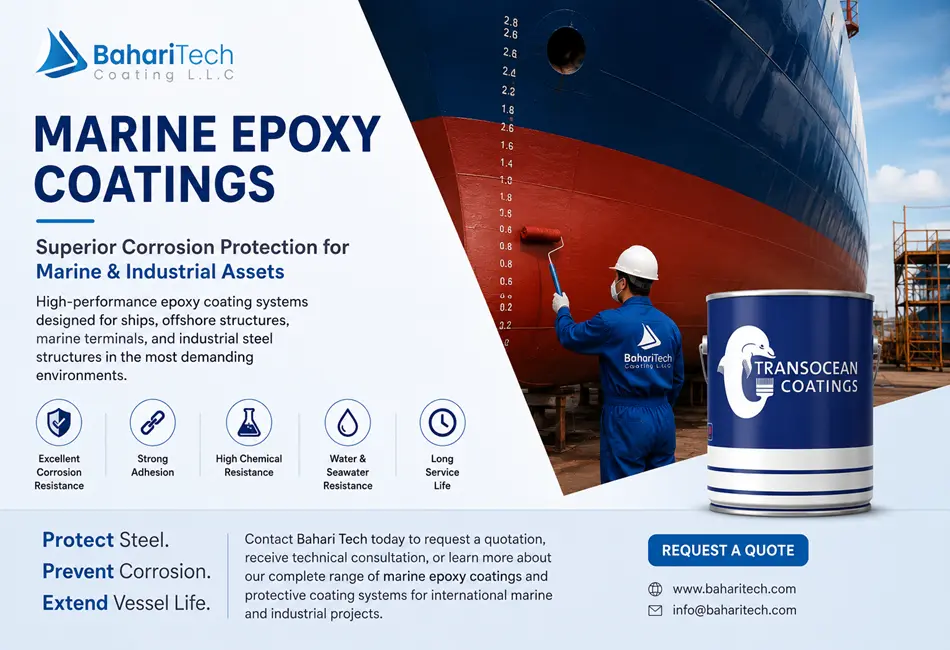
Marine Epoxy Coatings: Complete Guide to Applications, Benefits and Corrosion Protection
Marine epoxy coatings are among the most widely used protective coating systems in the maritime industry. Designed to provide exceptional corrosion resistance, chemical protection, and long-term durability, these coatings play a vital role in protecting ships, offshore structures, marine terminals, and industrial steel assets from harsh environmental conditions.
Unlike conventional paints, marine epoxy coatings create a dense and highly adhesive barrier that prevents seawater, moisture, oxygen, and corrosive chemicals from reaching the steel substrate. This protective barrier significantly reduces corrosion, extends the service life of marine assets, and lowers maintenance costs throughout the vessel’s operational lifetime.
Modern commercial vessels operate in some of the world’s most demanding environments, where saltwater, ultraviolet radiation, humidity, temperature fluctuations, cargo handling operations, and mechanical abrasion constantly challenge protective coating systems. Selecting the right marine epoxy coating is therefore essential for ensuring long-term structural integrity and reliable vessel performance.
Today, marine epoxy coatings are used throughout the global shipping industry on ballast tanks, cargo holds, decks, engine rooms, offshore platforms, pipelines, marine terminals, port infrastructure, and numerous industrial steel structures requiring superior corrosion protection.
What Are Marine Epoxy Coatings?
Marine epoxy coatings are two-component protective coating systems consisting of an epoxy resin and a curing agent (hardener). When mixed together, these components undergo a chemical reaction that forms a highly durable, chemically resistant, and strongly bonded protective film.
Compared with many traditional coating systems, epoxy coatings offer superior adhesion to properly prepared steel surfaces while providing outstanding resistance against moisture, chemicals, abrasion, and marine corrosion.
Marine epoxy coatings are commonly used as primers, intermediate coats, tank coatings, cargo hold coatings, ballast tank coatings, and heavy-duty protective systems for steel structures operating in aggressive marine environments.
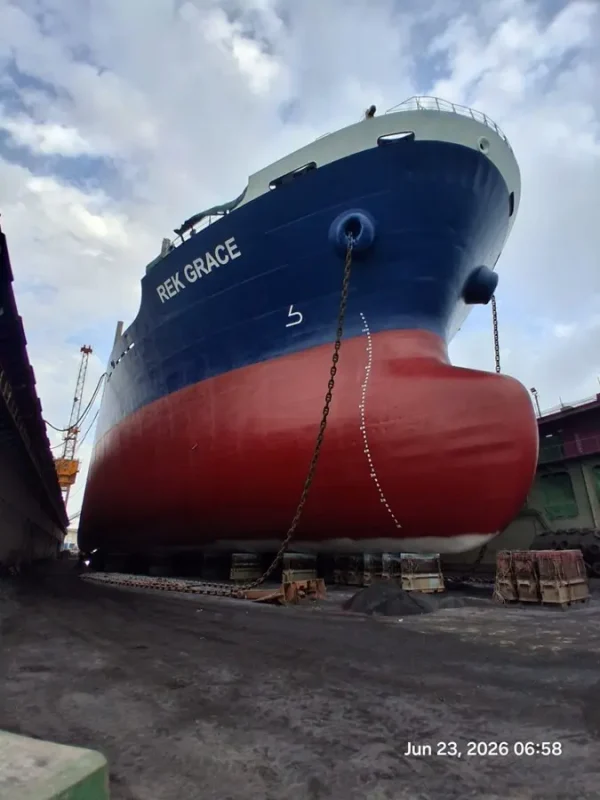
Marine Epoxy Coatings
Why Marine Epoxy Coatings Are Essential
Corrosion is one of the most significant challenges facing the maritime industry. Every year, ship owners invest substantial resources in maintenance, steel replacement, and coating repairs caused by corrosion damage.
Marine epoxy coatings help prevent these problems by creating a highly impermeable barrier between steel surfaces and corrosive elements such as seawater, oxygen, salt deposits, industrial pollutants, and chemical cargo residues.
By minimizing corrosion, epoxy coating systems contribute to:
- Long-term corrosion protection
- Extended vessel lifespan
- Reduced maintenance costs
- Lower dry dock expenses
- Improved operational efficiency
- Enhanced structural integrity
- Better asset reliability
- Reduced lifecycle ownership costs
For commercial shipping companies, offshore operators, shipyards, and industrial facilities, investing in high-quality marine epoxy coatings represents one of the most cost-effective strategies for long-term asset protection.
Key Properties of Marine Epoxy Coatings
Marine epoxy coatings are selected because they combine several important protective characteristics within a single coating system.
Their primary performance advantages include:
- Excellent corrosion resistance
- Outstanding adhesion to steel surfaces
- High chemical resistance
- Excellent water resistance
- Strong abrasion resistance
- Superior mechanical strength
- Long service life
- Excellent resistance to seawater immersion
- High durability under harsh operating conditions
- Compatibility with multi-coat marine coating systems
These properties make epoxy coatings one of the preferred solutions for protecting marine structures exposed to continuous moisture, saltwater, and aggressive operating environments.
Common Types of Marine Epoxy Coatings
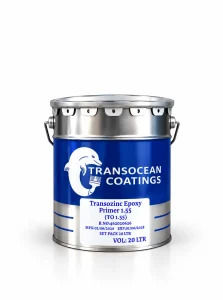
Epoxy Primers
Epoxy primers provide exceptional adhesion and corrosion protection, forming the foundation of many marine coating systems. They create a durable bond between the steel substrate and subsequent coating layers.
High-Build Epoxy Coatings
High-build epoxy coatings provide increased dry film thickness, delivering enhanced protection against corrosion, moisture penetration, and mechanical wear in demanding marine applications.
Surface-Tolerant Epoxy Coatings
Surface-tolerant epoxy systems are designed for maintenance applications where complete abrasive blasting may not be practical. They offer reliable adhesion to properly prepared existing coatings and steel surfaces.
Epoxy Tank Coatings
Specialized epoxy tank coatings protect ballast tanks, potable water tanks, chemical tanks, and cargo tanks against corrosion and chemical attack while maintaining long-term coating performance.
Heavy-Duty Industrial Epoxy Coatings
These coating systems are commonly used on offshore platforms, marine terminals, bridges, pipelines, port infrastructure, and industrial steel structures exposed to severe environmental conditions.
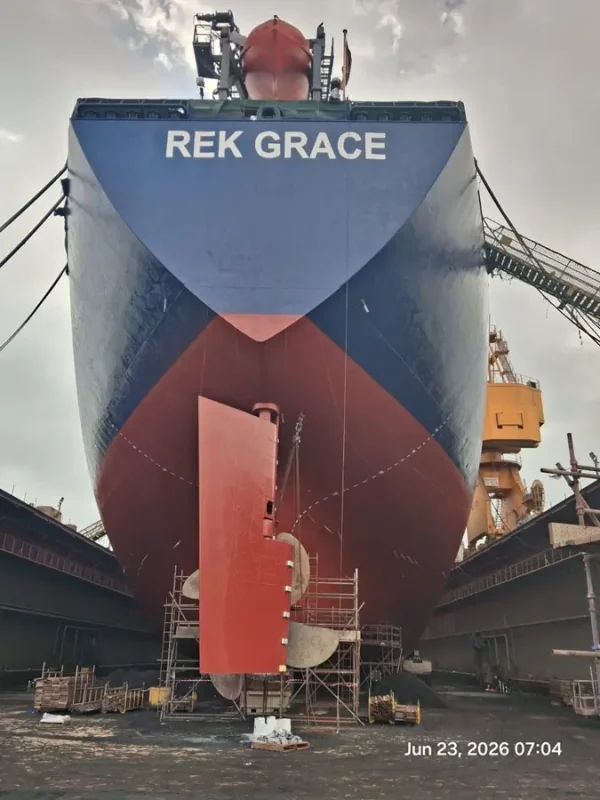
epoxy coatings
Where Marine Epoxy Coatings Are Used
Marine epoxy coatings are used throughout the maritime and offshore industries because of their versatility and outstanding protective performance.
Typical applications include:
- Commercial vessels
- Bulk carriers
- Container ships
- Oil and chemical tankers
- Cargo holds
- Ballast tanks
- Ship decks
- Engine rooms
- Offshore platforms
- Marine terminals
- Port infrastructure
- Steel bridges
- Industrial plants
- Storage tanks
- Marine pipelines
- Offshore energy facilities
As international shipping continues to grow across Singapore, China, Malaysia, Indonesia, Thailand, Vietnam, Saudi Arabia, Oman, Yemen, the United Arab Emirates, and other global maritime markets, marine epoxy coatings remain one of the most reliable and cost-effective solutions for long-term corrosion protection.
Industries That Use Marine Epoxy Coatings
Marine epoxy coatings are widely used across numerous marine and industrial sectors where long-term corrosion protection is essential.
- Commercial Shipping
- Shipbuilding
- Offshore Oil & Gas
- Ports and Marine Terminals
- Offshore Wind Farms
- Industrial Manufacturing
- Marine Infrastructure
- Steel Fabrication
Advantages of Marine Epoxy Coatings
Marine epoxy coatings have become the preferred protective coating system for commercial vessels, offshore structures, and industrial facilities because of their exceptional durability and corrosion resistance. Compared with conventional paint systems, epoxy coatings provide long-lasting protection that significantly reduces maintenance requirements and extends the service life of valuable marine assets.
Their outstanding mechanical strength and excellent adhesion make them suitable for both new construction and maintenance projects across the global maritime industry.
- Excellent corrosion resistance
- Outstanding adhesion to steel surfaces
- High resistance to seawater immersion
- Superior abrasion resistance
- Excellent chemical resistance
- Long service life
- Reduced maintenance costs
- Improved operational efficiency
- Extended dry dock intervals
- Reliable long-term asset protection
Surface Preparation Before Applying Marine Epoxy Coatings
Proper surface preparation is one of the most important factors affecting coating performance. Even the highest-quality marine epoxy coating cannot achieve its full service life if applied over poorly prepared steel surfaces.
Before application, steel should be cleaned to remove rust, mill scale, oil, grease, dust, moisture, chlorides, and previous coating residues. Abrasive blasting is generally recommended to create an appropriate surface profile that maximizes coating adhesion.
Typical preparation procedures include:
- Abrasive blasting
- Rust removal
- Degreasing
- Dust cleaning
- Salt contamination testing
- Surface profile inspection
- Humidity and temperature monitoring
Careful preparation improves coating adhesion, reduces premature coating failure, and helps maximize corrosion protection throughout the coating’s service life.
Marine Epoxy Coating Application Process
Successful coating performance depends not only on product quality but also on correct application procedures. Marine epoxy coatings should always be applied according to the manufacturer’s technical specifications and environmental requirements.
The typical application process includes:
- Surface preparation
- Inspection of steel condition
- Mixing epoxy resin and hardener
- Applying the primer coat
- Applying intermediate epoxy coats
- Measuring dry film thickness
- Final inspection and curing
Following these procedures helps ensure consistent coating performance, excellent adhesion, and long-term durability in demanding marine environments.
Common Causes of Epoxy Coating Failure
Although marine epoxy coatings are highly durable, improper application or poor maintenance can significantly reduce their effectiveness.
Common causes of coating failure include:
- Inadequate surface preparation
- Incorrect mixing ratios
- Application under unsuitable weather conditions
- Insufficient coating thickness
- Poor curing conditions
- Mechanical impact damage
- Continuous standing water
- Chemical contamination
- Delayed maintenance
Routine inspections and timely repair of damaged areas help prevent localized defects from developing into widespread corrosion problems.
Marine Epoxy Coatings vs. Polyurethane Coatings
| Property | Marine Epoxy Coatings | Polyurethane Coatings |
|---|---|---|
| Corrosion Resistance | Excellent | Very Good |
| Chemical Resistance | Excellent | Good |
| Abrasion Resistance | Excellent | Very Good |
| UV Resistance | Moderate | Excellent |
| Typical Application | Primers, ballast tanks, cargo holds | Topcoats and exterior finishing |
In many marine coating systems, epoxy coatings are used as primers and intermediate coats because of their excellent corrosion resistance, while polyurethane coatings are applied as finishing coats to provide superior UV resistance, gloss retention, and weather protection.
Marine Epoxy Coatings Across Southeast Asia and the Middle East
The demand for marine epoxy coatings continues to grow rapidly throughout Singapore, China, Malaysia, Indonesia, Thailand, Vietnam, the Philippines, Saudi Arabia, Oman, Yemen, and the United Arab Emirates. These regions represent some of the world’s busiest commercial shipping routes, offshore energy hubs, and shipbuilding centers.
Marine structures operating in tropical climates and salt-rich coastal environments require advanced epoxy coating systems capable of resisting corrosion, humidity, chemical exposure, and continuous seawater immersion.
Ship owners, offshore operators, marine contractors, and industrial facilities throughout Southeast Asia and the Middle East increasingly rely on high-performance marine epoxy coatings to improve asset reliability, reduce maintenance costs, and extend the operational life of critical infrastructure.
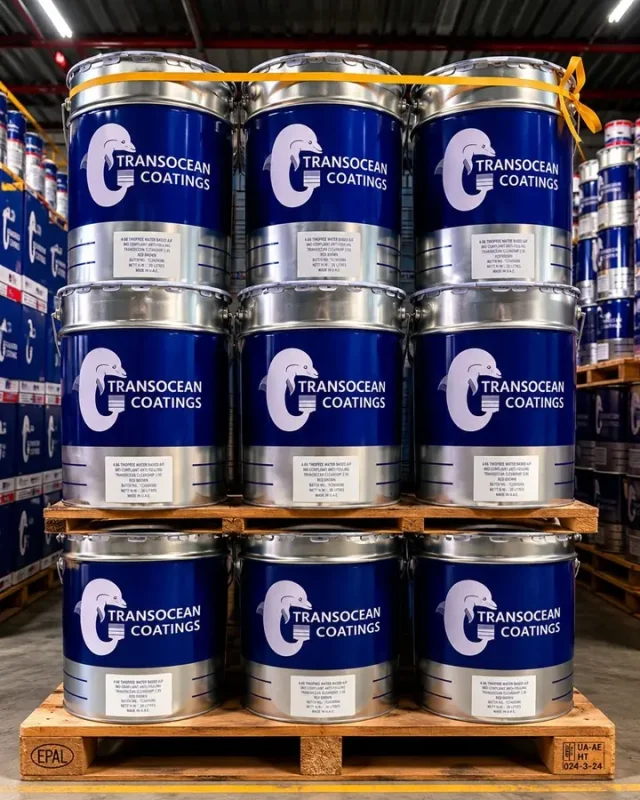
epoxy coatings
Comparison of Common Marine Epoxy Coating Systems
| Coating Type | Main Benefit | Typical Applications |
|---|---|---|
| Epoxy Primer | Excellent adhesion and corrosion protection | Steel preparation |
| High-Build Epoxy | Heavy-duty protection | Cargo holds and ballast tanks |
| Surface-Tolerant Epoxy | Maintenance applications | Repair projects |
| Epoxy Tank Coating | Chemical and water resistance | Ballast and storage tanks |
| Heavy-Duty Epoxy | Maximum durability | Offshore platforms and marine terminals |
Future Trends in Marine Epoxy Coating Technology
Marine coating manufacturers continue to develop innovative epoxy technologies that improve corrosion protection, environmental performance, and operational efficiency. Current trends include low-VOC formulations, advanced curing technologies, higher abrasion resistance, environmentally responsible raw materials, and smart coating systems that simplify maintenance planning.
These innovations enable ship owners and industrial operators to reduce lifecycle costs while maintaining compliance with modern environmental regulations and international marine coating standards.
Marine epoxy coatings remain one of the most reliable and cost-effective protective solutions for ships, offshore platforms, marine infrastructure, and industrial steel structures. Their exceptional corrosion resistance, strong adhesion, chemical durability, and long service life make them an essential component of modern marine coating systems.
By selecting the appropriate epoxy coating system and following proper surface preparation, application, and maintenance procedures, ship owners can significantly reduce maintenance expenses, improve operational efficiency, extend vessel lifespan, and protect valuable marine assets against harsh environmental conditions.
As global shipping, offshore energy projects, and marine infrastructure continue to expand throughout Singapore, China, Malaysia, Indonesia, Thailand, Vietnam, the Philippines, Saudi Arabia, Oman, Yemen, the United Arab Emirates, and other international maritime markets, high-performance marine epoxy coatings remain one of the most effective investments for long-term corrosion protection.
Frequently Asked Questions (FAQ)
What are marine epoxy coatings?
Marine epoxy coatings are two-component protective coating systems that provide excellent corrosion resistance, chemical protection, and long-term durability for marine and industrial steel structures.
Why are marine epoxy coatings important?
They protect vessels and offshore structures against corrosion, seawater, chemicals, abrasion, and moisture while extending service life and reducing maintenance costs.
Where are marine epoxy coatings commonly used?
Marine epoxy coatings are widely used on ballast tanks, cargo holds, decks, engine rooms, storage tanks, offshore platforms, pipelines, marine terminals, shipyards, and industrial steel structures.
How long do marine epoxy coatings last?
The lifespan depends on environmental conditions, coating thickness, maintenance practices, and application quality. Properly applied systems can provide many years of reliable protection.
Are marine epoxy coatings waterproof?
Yes. Marine epoxy coatings provide excellent resistance to seawater immersion, moisture penetration, and humid marine environments.
What is the difference between epoxy and polyurethane marine coatings?
Epoxy coatings offer superior corrosion and chemical resistance, making them ideal for primers and intermediate coats. Polyurethane coatings provide excellent UV resistance, color retention, and weatherability, making them suitable as finish coats.
Can marine epoxy coatings reduce maintenance costs?
Yes. High-performance epoxy coating systems minimize corrosion damage, reduce repair frequency, extend maintenance intervals, and lower overall lifecycle costs.
Which industries use marine epoxy coatings?
Commercial shipping, offshore oil and gas, shipbuilding, marine logistics, ports, industrial manufacturing, marine infrastructure, and offshore renewable energy industries all depend on marine epoxy coatings.
Are marine epoxy coatings suitable for tropical climates?
Absolutely. Marine epoxy coatings are specifically designed to perform in high-humidity, salt-rich, and high-temperature environments commonly found throughout Southeast Asia and the Middle East.
How do I choose the right marine epoxy coating?
The correct coating depends on the vessel type, operating environment, exposure conditions, maintenance schedule, and project requirements. Consulting experienced marine coating specialists helps ensure the best long-term protection.
Bahari Tech Marine Epoxy Coating Solutions Across Global Maritime Markets
Bahari Tech supplies premium marine epoxy coatings, anti-corrosion coatings, epoxy primers, epoxy tank coatings, cargo hold coatings, ballast tank coatings, polyurethane coatings, and industrial protective coating systems to customers throughout Singapore, China, Malaysia, Indonesia, Thailand, Vietnam, the Philippines, Saudi Arabia, Oman, Yemen, the United Arab Emirates, and other international maritime markets.
Our coating solutions are trusted by ship owners, shipyards, offshore operators, marine contractors, industrial facilities, and infrastructure developers operating in some of the world’s busiest shipping corridors and offshore energy regions.
Bahari Tech provides coating solutions for:
- Commercial vessels
- Bulk carriers
- Container ships
- Oil and chemical tankers
- Cargo holds
- Ballast tanks
- Ship decks
- Marine terminals
- Port infrastructure
- Offshore platforms
- Industrial steel structures
- Offshore energy facilities
- Shipbuilding projects
Whether your operations are located in Singapore, Shanghai, Kuala Lumpur, Jakarta, Bangkok, Ho Chi Minh City, Manila, Jeddah, Muscat, Aden, Dubai, or other major maritime hubs, Bahari Tech provides reliable coating solutions engineered for demanding marine and industrial environments.
Our commitment to quality products, technical expertise, and long-term corrosion protection helps customers improve operational efficiency, reduce maintenance costs, extend asset lifespan, and comply with international marine coating standards.
Request a Quote for Marine Epoxy Coatings
Looking for high-performance marine epoxy coatings, anti-corrosion coating systems, or expert technical advice for your marine or industrial project?
Contact Bahari Tech today to request a quotation, receive professional technical consultation, or learn more about our complete range of marine epoxy coatings and protective coating solutions for commercial vessels, offshore structures, marine terminals, and industrial facilities across Southeast Asia, the Middle East, and global maritime markets.
Protect Steel. Prevent Corrosion. Extend Vessel Life with Bahari Tech Marine Coating Solutions.