

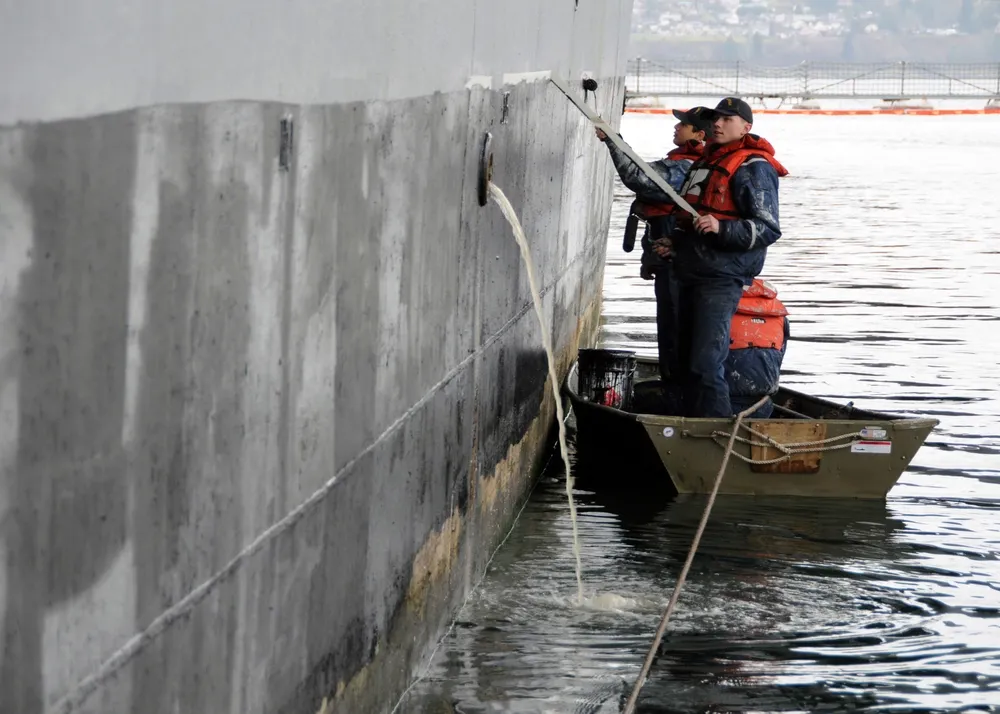
Marine topcoats and finishes are the visible skin of a vessel or offshore structure. They face sun, salt spray, rain and daily wear, and they decide how a ship looks and how long the paint beneath stays protected. Pick the wrong product and the gloss fades, the colour chalks and the next repaint arrives years early.
This guide is written for purchasing managers, superintendents and contractors in the UAE and Oman. It explains how to choose a polyurethane finish for marine topcoats and finishes, how it compares with alkyd and acrylic options, and what to check before you order.
Contents
- What are marine topcoats and finishes?
- Where the topcoat sits in the coating system
- Why UV, salt and wear decide topcoat life
- Alkyd, acrylic and polyurethane topcoats compared
- How to choose a polyurethane finish
- TransOcean finishes at a glance
- Topside paint application checklist
- Common mistakes to avoid
- What to send us when you request a quote
- Frequently asked questions
What are marine topcoats and finishes?
A marine topcoat is the final layer of a coating system. Together, marine topcoats and finishes make up the outer part of the protection. It is applied over the primer and any intermediate coat. Its job is to resist weather and give the surface its colour and gloss.
Topcoats are used on the topsides, boottop, decks, superstructures, hatch covers and funnels. They are also used on port cranes and offshore steelwork above the splash zone. A good topside paint keeps a clean appearance and makes washing easier.
Underwater areas are a different job. Those surfaces use antifouling and immersion systems, planned with their own paint consumption figures.
Where the topcoat sits in the coating system
A typical atmospheric system has three jobs split across layers:
- Primer: bonds to the prepared steel and fights corrosion.
- Intermediate (build) coat: adds film thickness and a barrier against water and salts.
- Topcoat: resists UV, keeps colour and gloss, and takes the abuse.
The topcoat is thin compared with the rest, but it protects everything under it. If it fails by chalking or cracking, the layers below are exposed. Always confirm that the topcoat is compatible with the primer and intermediate coat in the same system, and follow the product data sheet for recoat intervals.
Why UV, salt and wear decide topcoat life
Gulf and Omani waters bring intense sunlight, high humidity and salt-laden air. Marine topcoats and finishes have to handle all three at once.
UV exposure
Ultraviolet light breaks down the binder in many paints. The result is chalking, colour shift and loss of gloss. Binders designed for UV resistance keep their look much longer. You can read more about the radiation itself in this overview of ultraviolet light.
Salt and moisture
Salt on a dirty surface draws moisture under the film and causes blisters. Clean, well-washed surfaces before every recoat.
Mechanical wear
Decks see foot traffic, wires, chains and cargo gear. Hardness and abrasion resistance matter most here. Hull sides suffer from fenders, tugs and berthing contact.
Alkyd, acrylic and polyurethane topcoats compared
Three binder families dominate marine topcoats and finishes. Each has a place.
| Type | Packs | Strengths | Typical use |
|---|---|---|---|
| Modified alkyd | 1 | Easy to apply, good gloss, economical | Maintenance of topsides, decks, superstructures |
| Acrylic | 1 | Fast drying, good colour stability | Touch-up and quick turnaround work |
| Polyurethane | 2 | High gloss retention, strong colour retention, hard film | New builds, dry-dock repaints, long-life topsides |
For a quick, low-cost maintenance repaint, a one-pack alkyd can be enough. For longer repaint intervals, a two-pack polyurethane is usually the better investment. Our own guide to polyurethane marine coatings explains the chemistry in more depth.
How to choose a polyurethane finish
When you compare marine topcoats and finishes of the polyurethane type, look at five points.
1. Gloss retention
Gloss retention is how well the shine survives sun and weather. Ask for the manufacturer’s data and real service references, not just the day-one gloss.
2. Colour retention
Dark colours and bright reds fade fastest in strong sun. A UV-stable binder keeps the colour closer to the original shade.
3. Hardness and wear
Hard films resist scuffs on decks and handrails. They also stay cleaner, because dirt grips less.
4. Application method
Check that the finish suits airless spray, air spray, brush or roller, depending on the area and your crew.
5. Recoat and cure times
Two-pack products have a pot life and a recoat window. In hot weather both are shorter. Plan batches so mixed paint is used within its pot life.
TransOcean finishes at a glance
Bahari Tech supplies the TransOcean range in the UAE and Oman. Three finishes cover most topside needs:
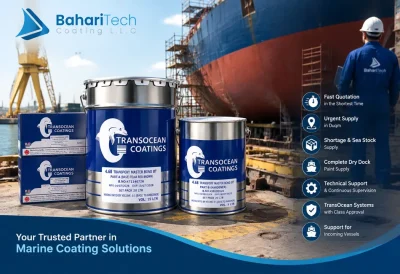
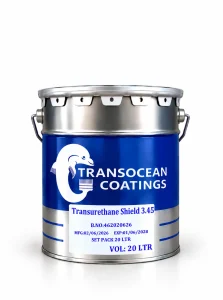
- Transurethane Finish (TO 3.43) is formulated with selected acrylic resins and isocyanate curing agents. It is intended for atmospheric exposure, including intense UV in tropical climates.
- Transothane Finish 3.63 is a high-gloss, two-component polyurethane finish for marine and industrial environments, with good colour retention. It can be applied by airless spray, air spray, brush or roller.
- Transolac Finish 3.31 is a single-component modified alkyd topcoat for boottop, topsides, decks and superstructures, with good gloss retention and a wide colour range.
For marine topcoats and finishes in this range, choose the polyurethane grades when you want the longest appearance life. Choose the alkyd when you want simple, single-pack maintenance. The data sheets are available on our documents and downloads page.
Topside paint application checklist
Even the best of the marine topcoats and finishes fails if it is applied badly. Use this short list:
- Check that the previous coat is clean, dry and free of salt, oil and chalk.
- Confirm the surface temperature is above the dew point by the margin stated in the data sheet. This is typically a few degrees.
- Mix the base and curing agent exactly in the stated ratio.
- Apply even wet films. Measure with a wet film gauge.
- Respect the recoat window between coats.
- Check dry film thickness against the specification.
- Protect fresh paint from rain, dust and spray until it has cured.
Common mistakes to avoid
- Choosing marine topcoats and finishes on price per litre instead of cost per year of service.
- Mixing more two-pack paint than the crew can apply before pot life ends.
- Recoating outside the stated window without light abrasion.
- Painting in direct midday sun, which can cause dry spray and poor flow.
- Ordering by colour name only. Always give the colour code.
What to send us when you request a quote
To recommend the right marine topcoats and finishes quickly, please share:
- The vessel or structure type and the areas to be painted.
- The existing coating system and its condition.
- The area in square metres, or drawings, so we can estimate quantity.
- The colour codes and gloss level you need.
- The delivery location in the UAE or Oman and your timeline.
Frequently asked questions
What are marine topcoats and finishes?
Marine topcoats and finishes are the final protective layer of a coating system. Applied over the primer and intermediate coat, they resist sunlight, salt spray and abrasion while providing colour and gloss. They are used on topsides, decks, superstructures and port or offshore steelwork above the splash zone.
Why choose a polyurethane finish for topsides?
A polyurethane finish is a two-pack coating known for hard film, strong gloss retention and good colour stability in sunlight. These qualities help topsides and decks keep their appearance longer between repaints. It costs more to apply than a one-pack paint, so it suits areas where long service life matters.
What is gloss retention in a marine topcoat?
Gloss retention describes how much shine a topcoat keeps after exposure to sun, weather and washing. A topcoat with good gloss retention looks newer for longer and stays easier to clean. Ask suppliers for data sheets and service references, not just the initial gloss level.
Can I apply a polyurethane finish over an alkyd topcoat?
It depends on the condition of the old coating and the product data sheet. The old alkyd must be clean, sound and lightly abraded, and a compatibility test patch is strongly advised. When in doubt, ask your supplier before painting a large area, because incompatibility can cause lifting or wrinkling.
How long does a marine topcoat last?
Service life depends on the product, the colour, the surface preparation, film thickness and the exposure. Hot, sunny Gulf conditions are demanding, and dark colours age faster. No honest supplier can promise one figure for every ship, so base your plan on the data sheet and on inspections.
What affects topside paint application the most?
Surface cleanliness, weather and correct mixing matter most. The surface must be free of salt, oil and dust, and above the dew point by the margin on the data sheet. Two-pack paints must also be mixed in the stated ratio and used within their pot life.
Do I need a different topcoat for decks and hull sides?
Often yes. Decks need hardness and abrasion resistance for foot traffic and cargo gear, and some need a non-slip finish. Hull sides need gloss and colour retention plus tolerance of berthing contact. Many polyurethane finishes suit both, but check the data sheet for each area.
Get the right finish for your next repaint
Choosing among marine topcoats and finishes is much easier with the right technical input. Tell us about your project and our team will suggest a suitable finish, confirm availability and send the data sheets. Contact Bahari Tech for a quote or browse our polyurethane marine coatings.