

Marine paint consumption is the first number every buyer needs before asking for a quote. Order too little and the dry-dock slips. Order too much and cash sits on the shelf. This guide shows a simple, repeatable way to estimate how much paint a ship needs.
It is written for purchasing managers, superintendents and contractors in the UAE and Oman. You only need the hull area, the coating specification and the product data sheet.
Table of Contents
Why Marine Paint Consumption Matters Before You Request a Quote
A supplier can only quote a firm quantity when your inputs are clear. A rough estimate also helps you compare offers on a fair basis.
Good estimates protect three things:
- Budget: paint is often a large share of a repair package.
- Schedule: a short delivery of one coat can stop work in the dock.
- Quality: thinning paint to stretch it lowers film thickness and protection.
If you are still choosing products, start with our guide on what marine paints are and how they differ.
Key Terms: Volume Solids, DFT and Theoretical Spreading Rate
Three values drive every paint coverage calculation. All three are on the product data sheet.
Volume solids (VS)
Volume solids is the share of the wet paint that stays on the surface after the solvent leaves. A paint with 80% VS leaves 80 litres of dry film from every 100 litres applied.
Dry film thickness (DFT)
DFT is the thickness of the dry coat, measured in microns (µm). The specification sets the DFT for each coat. Do not change it to save paint.
Theoretical spreading rate (TSR)
The theoretical spreading rate is the area one litre covers at the target DFT on a perfectly smooth surface. It assumes zero loss.
TSR (m²/L) = VS% × 10 ÷ DFT (µm)
The 7-Step Marine Paint Consumption Formula
Follow these steps for each coat in the system. Repeat the steps for every area, such as the underwater hull, topsides and tanks.
- Measure the area. Use the ship’s drawings or the shipyard’s surface list.
- Take the specified DFT for the coat from the coating specification.
- Read the volume solids from the product data sheet.
- Calculate the TSR with the formula above.
- Calculate the theoretical volume: area ÷ TSR.
- Apply the loss factor (explained below).
- Round up to full pack sizes and add a small touch-up reserve.
The practical formula combines steps 4 to 6:
Paint needed (L) = Area (m²) × DFT (µm) ÷ (VS% × 10) ÷ (1 − loss)
How to Estimate Hull Area for Paint Quantity
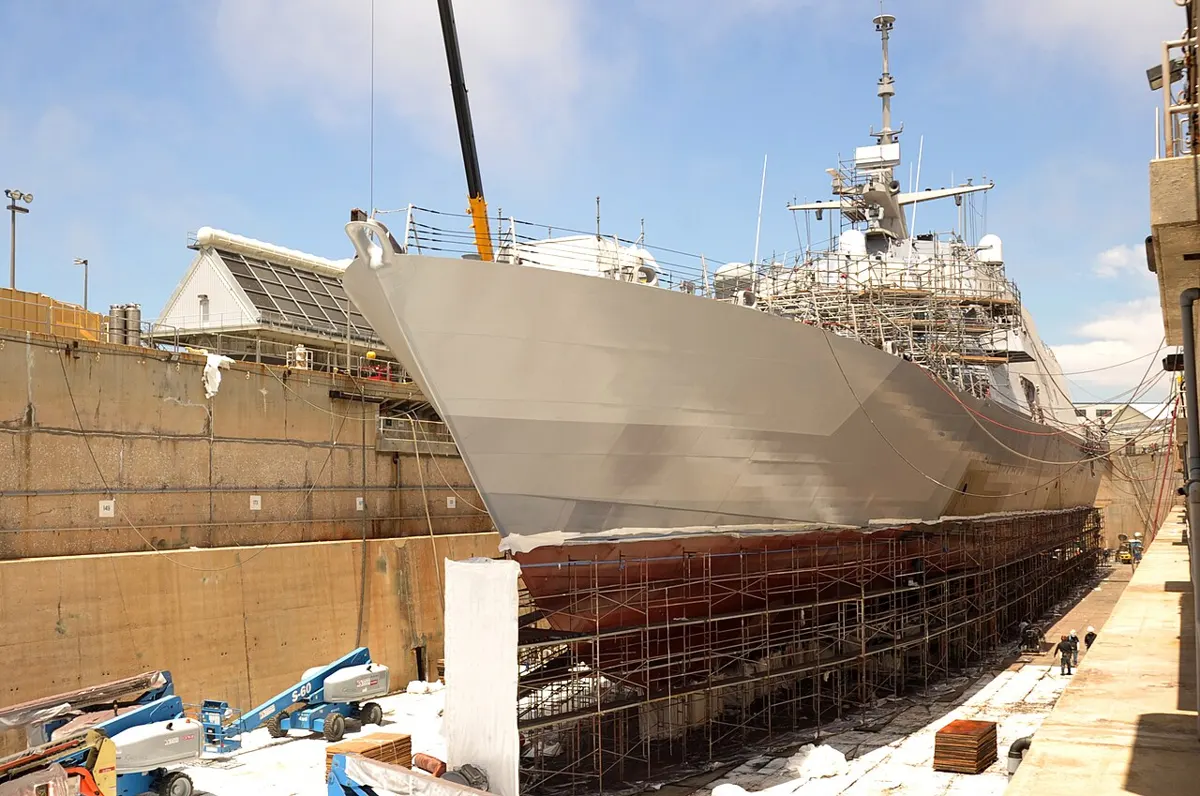
Hull area paint quantity starts with the wetted surface for the underwater hull. Classic naval architecture approximations, such as Mumford’s formula, use the length, beam, draught and block coefficient. They are good for early budgeting.
For an order, do not rely on a formula alone. Ask for the shipyard’s hull area from the docking plan or the vessel’s own coating records. Treat these areas separately:
- Underwater hull (antifouling and anti-corrosive coats)
- Boot-top and topsides
- Deck and superstructure
- Ballast and cargo tanks
Tank areas come from the tank plan. Our article on ballast tank coatings explains why tank coating specifications are strict.
Paint Loss Factor: Why You Always Order More Than the Theory
The paint loss factor covers every litre that does not end up as dry film on the steel. Real jobs always lose some paint.
Common causes of loss include:
- Overspray and wind drift during spraying
- Paint left in hoses, pumps and pots
- Rough or pitted steel that needs a thicker film to cover the peaks
- Edges, weld seams and complex shapes
- Spills, tin residue and wasted mixed paint
Airless spray on a large flat hull loses less paint than brush and roller work on small, complex areas. Your applicator and the paint supplier can advise a realistic figure for your job. The loss factor in the next example is only an illustration.
Worked Example: Paint Coverage Calculation for a Hull Coat
This example uses round numbers to show the method. Replace them with the figures from your own specification and data sheet.
- Area: 2,000 m²
- Specified DFT: 250 µm
- Volume solids: 80%
- Assumed loss factor: 30%
Step 1 – TSR: 80 × 10 ÷ 250 = 3.2 m²/L.
Step 2 – Theoretical volume: 2,000 ÷ 3.2 = 625 L.
Step 3 – With loss: 625 ÷ (1 − 0.30) = about 893 L.
With 20-litre packs, you would order 45 packs (900 L). The same paint at 120 µm DFT would need less than half the volume, which shows why the specified DFT matters so much.
Calculating a Full Coating System
A hull system usually has several coats, for example a primer, an intermediate and an antifouling. Calculate each coat on its own, with its own VS and DFT. Then add the packs per product.
Keep these points in mind:
- Different coats have different VS and DFT values.
- Stripe coats on edges and welds add extra volume.
- Maintenance repairs usually need a smaller area than a full recoat.
Antifouling choice also affects the plan. Read what antifouling coatings are and our overview of marine primers and anti-corrosive coatings before you fix the system.
Common Mistakes That Distort Marine Paint Consumption
- Using wet film instead of dry film: the DFT is a dry value. Volume solids converts between them.
- Ignoring surface condition: poorly prepared or pitted steel takes more paint. See why surface preparation matters.
- Copying an old order: the product, DFT or area may have changed.
- Forgetting pack sizes: you buy full packs, not exact litres.
- Over-thinning: adding thinner beyond the data sheet limit cuts film thickness and warranty cover.
Planning Paint Supply in the UAE and Oman
Dry-dock slots are fixed, so paint must arrive before the surface is ready. Confirm the product, quantity, batch and delivery date well before blasting starts. Hot weather also affects pot life and application windows, so check the data sheet limits.
Bahari Tech supplies TransOcean marine and industrial coatings. See our main marine paint supplier page, or go to the local pages for Dubai and Oman. You can also browse the TransOcean paint range and the data sheet downloads.
For antifouling rules that affect product choice, see the IMO page on anti-fouling systems.
What to Send With Your Quote Request
A complete request gets a faster and more accurate quote. Send:
- Vessel name, type and dock location
- Areas to coat and their sizes
- The coating specification with DFT for each coat
- Preferred brand or system, if any
- Application method and delivery date
Marine Paint Consumption FAQ
How much paint does a ship need?
How do you calculate marine paint consumption?
What is the theoretical spreading rate of paint?
What is a paint loss factor?
Why is actual paint use higher than the calculated amount?
How do I estimate hull area for paint quantity?
What information should I send a supplier to get a paint quote?
Get Your Paint Quantity Checked
Send your area, specification and dock date, and our team will help you check the quantity and quote the right TransOcean system. Contact us today to get started.