


The spray crew finishes a section of hull. The inspector arrives the next morning, measures the dry coat and finds it 40 microns short. Now the section needs another coat, and the schedule slips. A simple check with wet film thickness, taken while the paint was still wet, would have caught the problem in seconds.
This guide is for painting supervisors, coating inspectors, shipyard buyers and contractors in the UAE and Oman. It explains how to measure and calculate wet film thickness (WFT) in six clear steps, with one worked example and a short reference table.
What wet film thickness (WFT) is and why it matters
Wet film thickness is the thickness of the paint film right after application, while it is still liquid. The paint contains solvent, and the solvent leaves as the film dries. What stays behind is the dry film thickness (DFT). Our guide to marine coating DFT covers the dry side in detail.
Why measure the wet film at all? Because you cannot fix a dry film cheaply. Wet film thickness gives you a quick estimate of the final DFT while you can still add or ease off paint. For large jobs, such as hulls, tanks and decks, this saves rework.
- WFT is a control tool during application.
- DFT is the number the specification accepts or rejects.
- WFT is a prediction. It is never the final proof.
Test methods exist for both. ASTM D4414 covers the measurement of wet film thickness by notch gauges, and ISO 2808 describes methods for determining film thickness of paints and varnishes.
How to measure wet film thickness: the 6-step method
Here is the whole routine in short form. Each step is explained below.
- Get the target DFT and the volume solids from the specification and the data sheet.
- Calculate the WFT with the formula.
- Adjust for thinning if you add thinner.
- Check the gauge before use.
- Measure the film right after application.
- Confirm with a dry film gauge after cure.
Step 1: Get the target DFT and the volume solids
You need two numbers before you spray. The first is the target dry film thickness for the coat. It comes from the project specification or the coating system. The second is the volume solids of the paint, which is the share of the wet paint that stays on the surface as dry film.
Both numbers are on the paint maker’s technical data sheet. Our guide to the marine coating technical data sheet shows where to find them. For the meaning of the figure, read volume solids in marine paint.
Be careful here. Use volume solids, not solids by weight. A paint can be 80% solids by weight and only 60% by volume, because pigments and fillers are heavy. Using the weight figure gives a WFT that is too low, and the dry coat ends up thin.
Step 2: Calculate WFT from DFT and volume solids
The formula is simple:
WFT = DFT ÷ (volume solids ÷ 100)
Example, with round numbers chosen only for illustration:
- Target DFT: 200 µm
- Volume solids: 60%
- WFT = 200 ÷ 0.60 = 333 µm
So the sprayer must lay down about 333 µm of wet paint to leave 200 µm dry. The table below applies the same formula for a few common cases. These are examples of the maths, not figures for a specific product. Always take the real volume solids from your data sheet.
| Target DFT (µm) | WFT at 50% VS (µm) | WFT at 60% VS (µm) | WFT at 70% VS (µm) | WFT at 80% VS (µm) |
|---|---|---|---|---|
| 100 | 200 | 167 | 143 | 125 |
| 150 | 300 | 250 | 214 | 188 |
| 200 | 400 | 333 | 286 | 250 |
| 250 | 500 | 417 | 357 | 313 |
Step 3: Adjust the wet film thickness for thinning
Thinner changes the maths. When you add thinner, you add volume that will evaporate and leave nothing behind. The paint is now less concentrated, so you must apply a thicker wet film to get the same dry film.
The adjusted formula is:
WFT = DFT ÷ (volume solids ÷ 100) × (1 + thinner %)
Continue the example. With 10% thinner added to the 60% volume solids paint:
- WFT = 333 × 1.10 = 367 µm
The target did not change, but the wet film must now be about 10% thicker. Many crews forget this step. They read the usual WFT from the data sheet, thin the paint for the heat, and finish with a thin dry film.
Only thin within the limit set by the maker, and with the thinner it recommends. Read our guide to marine paint thinner before you choose one for epoxy or polyurethane.
Step 4: Check your wet film thickness gauge
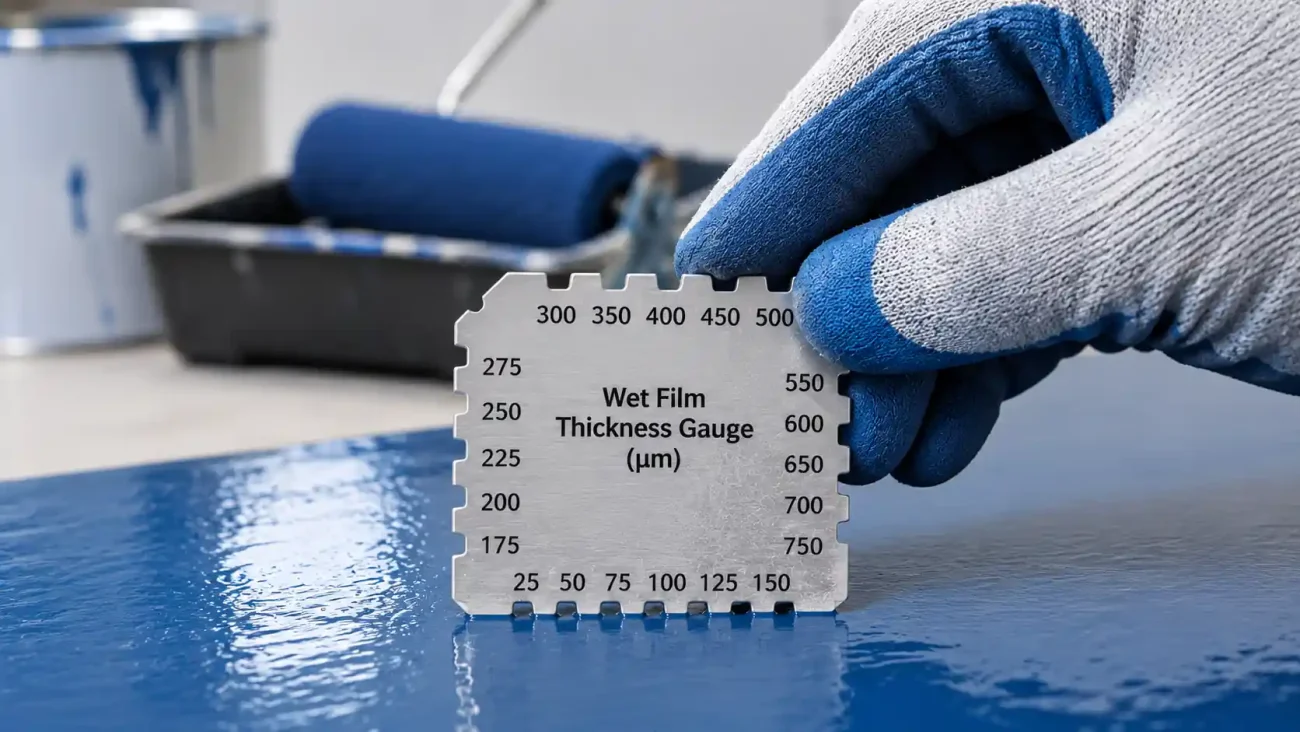
The most common wet film thickness gauge is the notched comb gauge. It is a flat metal or plastic plate with teeth along the edges. Each tooth is cut back by a known amount, and the depth is stamped next to each step.
Inspect the gauge before every job:
- Clean teeth. Dried paint in a notch changes its depth. Clean the gauge with the right thinner after each reading.
- Straight edges. A bent or dented plate gives false numbers.
- Correct range. Pick a gauge whose steps cover your target WFT, with some steps above and below.
- Readable markings. Worn numbers lead to reading errors.
Step 5: Measure the wet film right after application
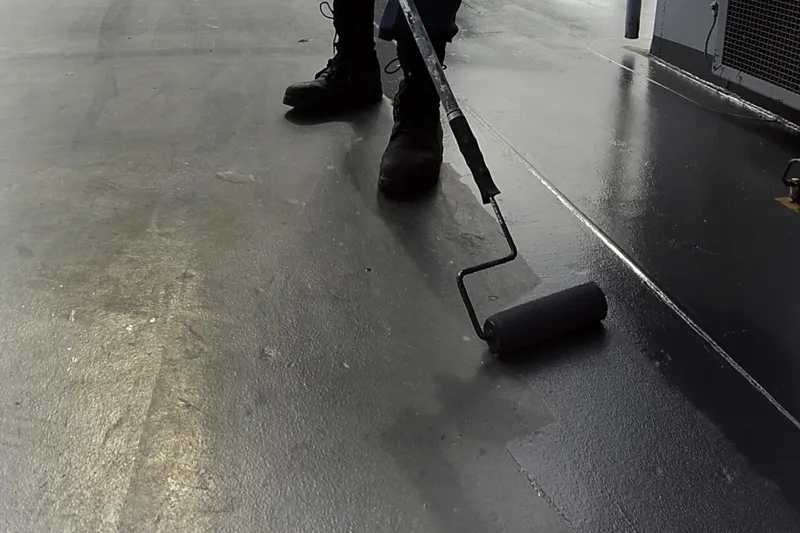
Now measure wet film thickness on the work. Speed matters, because solvent begins to leave the film at once. In the hot, dry air of the Gulf, this happens faster than in a cool climate.
- Choose a flat, representative area, away from edges, welds and corners.
- Hold the gauge square to the surface. Press it firmly through the wet film, so that the outer teeth touch the substrate.
- Lift the gauge straight off. Do not slide it sideways.
- Look at the teeth. The wet film thickness lies between the highest tooth that carries paint and the next tooth that is clean.
- Record the value, the location and the time.
- Repeat in several places across the area.
Reading between the teeth
The film will rarely wet a tooth exactly. Suppose the 300 µm tooth is wet and the 350 µm tooth is dry. The wet film is somewhere between 300 and 350 µm. Report it as that range, or use the wet tooth as a safe lower value, as your inspection plan states.
What if the reading is off target?
If the wet film is below the target, apply more paint on the next pass while the film is still workable. If it is far above, ease off, because heavy films tend to run and sag. Check your gun distance, speed and pressure. Our marine coating inspection checklist lists other checks to make before and during painting.
Step 6: Confirm the result with dry film thickness
WFT only estimates the final film. Real dry film can differ for several reasons: solvent loss, spray loss, film shrinkage and the roughness of the steel. On a blasted surface, part of the paint fills the valleys of the profile, so the DFT measured above the peaks can read lower than the calculated figure.
That is why the specification always asks for a dry film check after cure. Use a calibrated dry film gauge, follow the measuring plan in the specification, and compare the values with the target DFT. The wet film reading helps you reach that number on the first attempt.
For epoxy and polyurethane systems that must meet a stated DFT, see our TransOcean paint range, and ask for the data sheet of the exact product you plan to use.
Common mistakes when measuring wet film thickness
These mistakes cause most wrong WFT readings and thin dry films:
- Dirty or damaged gauge. Dried paint in the notches shifts every reading.
- Using solids by weight. The formula needs volume solids, which also drive marine paint consumption.
- Forgetting the thinner. Thinned paint needs a thicker wet film.
- Reading too late. Solvent has already left, so the number is too low.
- Measuring at edges or welds. Films are uneven there and the reading does not represent the surface.
- Sliding the gauge. This smears the film and gives false teeth marks.
- Treating WFT as final proof. Only the dry film check accepts the coat.
Frequently asked questions
What is wet film thickness (WFT)?
Wet film thickness is the thickness of a coating right after it is applied, before the solvent leaves. It is measured in microns (µm) or mils. Inspectors use it to predict the dry film thickness (DFT) while the work is still going on and the coat can still be corrected.
How do you calculate WFT from DFT?
Divide the target DFT by the volume solids of the paint as a fraction. For 200 µm DFT and 60% volume solids, WFT = 200 ÷ 0.60 = 333 µm. If you thin the paint, multiply the result by one plus the thinner fraction. Always use the volume solids from the data sheet.
Which wet film thickness gauge is best?
The notched comb gauge is the most common choice because it is cheap, simple and described in ASTM D4414. Choose the gauge whose steps cover your target WFT. Wheel gauges also exist. Whatever type you use, keep it clean, straight and undamaged, as bent or paint-clogged teeth give false readings.
Does thinning change the wet film thickness I need?
Yes. Thinner adds volume that later evaporates, so a thinned paint needs a thicker wet film to reach the same DFT. Add the thinning percentage to the calculation. Only thin within the limit stated by the paint maker, because over-thinning can cause runs, poor film build and loss of performance.
How soon must I read the WFT after spraying?
Read it immediately, in a few seconds. Solvent starts to flash off the moment the paint leaves the gun, and this happens faster in the heat of the UAE and Oman. A late reading shows a lower number than the real applied film and can lead you to apply too much paint.
Is WFT enough to accept a coating?
No. WFT is only a guide to control the job during application. The final acceptance is based on the dry film thickness, measured with a calibrated dry film gauge after the coat has cured, as the project specification requires. WFT helps you reach that number the first time.
Get a quote for marine paint with a specified DFT
Planning a coating job where the DFT is fixed by specification? Review the TransOcean marine paint range and request a quote there. Tell us the substrate, the target DFT and the site, and we will help you match the product and its data sheet. You can also contact our team with your questions.