

Marine coating DFT is the single number that tells you whether a paint job will do its work. A coating can look perfect and still be too thin to protect the steel. Skip the check, and you may find the problem only when rust returns.
This guide is for superintendents, purchasing managers, inspectors and contractors in the UAE and Oman. It explains how to measure and inspect film thickness, which gauges to use, and the mistakes that spoil readings.
Contents
- What is marine coating DFT?
- Why marine coating DFT matters on a ship
- Wet film thickness: the early warning
- Gauge types and calibration for marine coating DFT
- 7 steps to measure marine coating DFT
- Marine coating DFT acceptance: minimum, maximum and the 90/10 rule
- Common errors in marine coating DFT inspection
- What to put in the inspection report
- Frequently asked questions
What is marine coating DFT?
DFT stands for dry film thickness. It is the thickness of the cured paint film, measured in microns (one micron is a thousandth of a millimetre). For a multi-coat scheme, the DFT can be the thickness of one coat or of the whole system.
Every marine coating DFT target comes from the project specification and the product data sheet. The paint maker states a recommended range for each coat. The owner may add a stricter total for the system.
You will also hear the term NDFT, or nominal dry film thickness. It is the target value that the coating must reach. Our guide to the marine coating system shows how primer, midcoat and topcoat add up to the total.
Why marine coating DFT matters on a ship
Paint protects steel by forming a barrier, and marine coating DFT decides how strong that barrier is. A thicker barrier gives water, salt and oxygen a longer path to the steel. If the film is too thin, the barrier is weak. If it is too thick, the film can crack or hold solvent.
Edges, welds and corners are the usual weak points. Paint pulls away from them as it dries, so the film there is often thin. This is why a good marine coating DFT plan covers these areas too.
Thickness also drives cost. Applying more paint than needed wastes material, and applying too little means repair work. Read our article on marine paint consumption to see how film thickness changes the paint quantity you must order.
Wet film thickness: the early warning
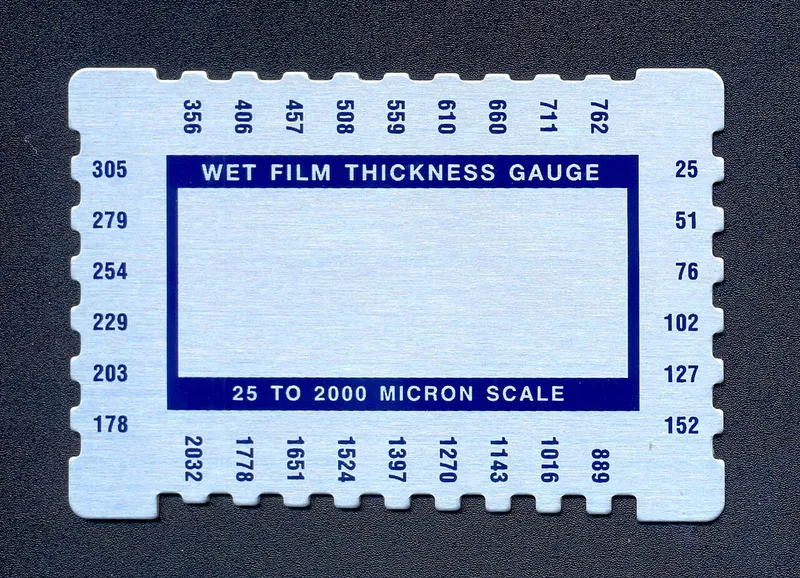
Wet film thickness (WFT) is measured while the paint is still wet. The painter presses a comb gauge into the film and reads the last tooth that is wet. It is quick, cheap and does not damage the coating.
WFT lets you fix a problem before the paint cures. The target WFT comes from the DFT target and the volume solids of the paint:
WFT = DFT ÷ volume solids (as a fraction)
For example, a coating with 60% volume solids and a 150 micron DFT target needs about 250 microns wet. Always take the volume solids figure from the data sheet of the product in use. If thinner is added, the volume solids drop, so the wet film must be raised to match.
Gauge types and calibration for marine coating DFT
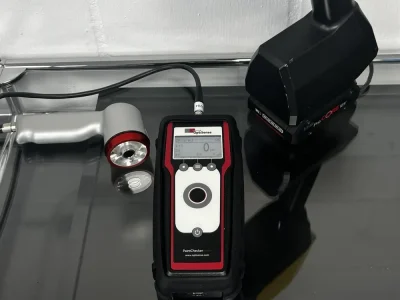
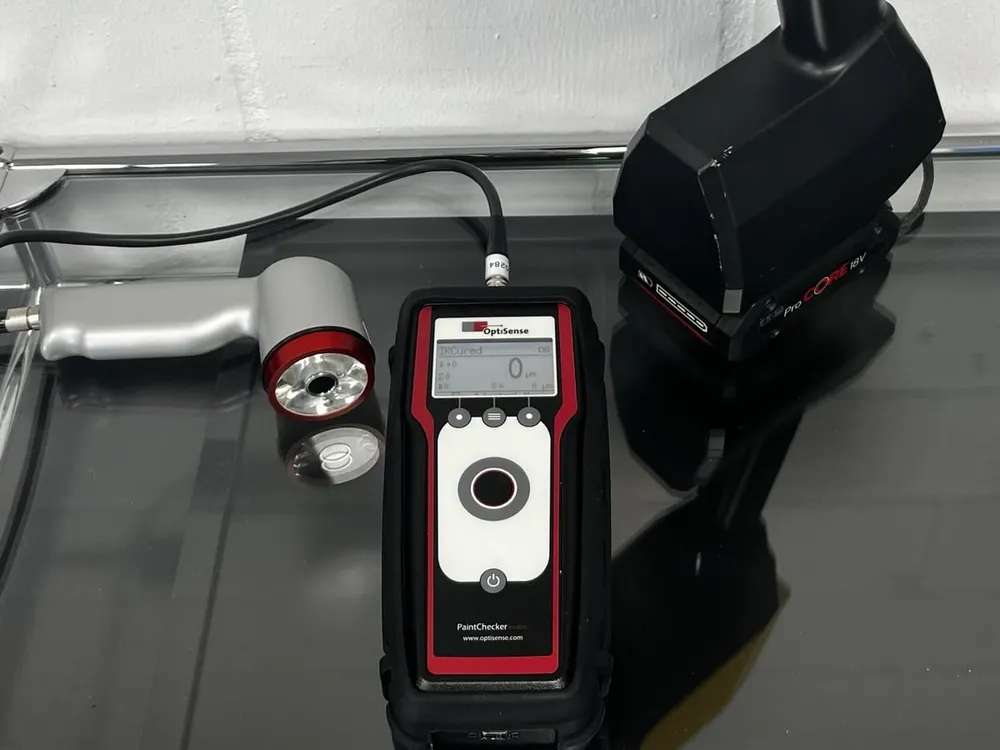
The right gauge for marine coating DFT depends on the base material. Most ship steel is ferrous, so magnetic or electronic gauges are the usual tools.
- Magnetic pull-off gauges: simple, robust and need no battery. They suit site work.
- Electronic magnetic gauges: give a digital reading and can store values for the report.
- Eddy current gauges: used for coatings on non-ferrous metals such as aluminium.
- Ultrasonic gauges: used when the coating sits on non-metal surfaces such as concrete or composites.
Calibration comes first. Check the gauge on a known reference before each shift, using certified shims or foils. Then adjust the gauge on an uncoated, blasted steel surface that matches the real work. Keep the calibration records, because the inspection report will need them.
7 steps to measure marine coating DFT
Use this sequence for every marine coating DFT inspection. It follows the common approach of the main standards, but the agreed inspection plan always has the final word.
Step 1: Read the specification
Note the minimum and maximum marine coating DFT for each coat and for the full system. Note the standard that sets the number of readings.
Step 2: Check the coating is cured
Measure only when the film is hard enough to take the probe without damage. The data sheet gives cure times at different temperatures.
Step 3: Calibrate the gauge
Verify it on shims, then adjust on bare blasted steel. Write down the shim values and the date.
Step 4: Divide the surface into areas
Split large surfaces into defined areas so every part is covered. Mark them on a plan or drawing.
Step 5: Take the readings
Place the probe flat and steady on the film. Take several readings at each spot and average them, as the standard requires. Spread the spots over the whole area, not only the easy places.
Step 6: Compare with the acceptance criteria
Check each spot against the minimum and maximum. Mark any spot that fails and measure the area around it to find how large the problem is.
Step 7: Record and report
Log the readings, gauge ID, calibration data, location and date. Decide with the owner how any low areas will be repaired.
Marine coating DFT acceptance: minimum, maximum and the 90/10 rule
Most specifications set both a minimum and a maximum marine coating DFT. Below the minimum, protection is weak. Above the maximum, the film may crack or retain solvent. Neither case is a pass.
For ballast tanks, the IMO PSPC uses the 90/10 rule. At least 90 percent of all readings must reach the nominal DFT, and the remaining readings must reach at least 90 percent of it. Our ballast tank coatings guide explains why tanks get this extra attention.
For the product-specific numbers, always use the data sheet. You can find them on our documents and downloads page. The marine epoxy coatings page lists the epoxy range that most tank and hull systems use.
Common errors in marine coating DFT inspection
- Uncalibrated or wrongly calibrated gauge. Every reading is then off.
- Rough steel profile. Peaks and valleys can make the gauge read high. Adjust on a bare blasted sample.
- Readings near edges. Gauges read wrongly close to edges and welds. Keep a safe distance as the manual states.
- Curved or small surfaces. Calibrate on a similar shape.
- Measuring uncured paint. The probe can dent the soft film.
- Averaging too few spots. A few good readings can hide a thin area.
- Ignoring thinner additions. More thinner means a lower dry film for the same wet film.
Good surface preparation reduces many of these errors. See our guide to marine coating surface preparation for the steps that come before painting.
What to put in the inspection report
A clear report protects both the contractor and the owner. Treat the marine coating DFT record as part of the vessel file. A complete marine coating DFT report should include:
- Vessel or project name, area and coating system
- Product names and batch numbers
- Specified minimum and maximum DFT
- Gauge model, ID and calibration record
- All readings, with locations
- Pass or fail result against the criteria
- Repair actions and re-inspection results
- Inspector name, date and signature
The unit of measure is the micron, also called the micrometre. See the micrometre page on Wikipedia if you need a refresher on the unit.
Frequently asked questions
What does DFT mean in marine coatings?
DFT means dry film thickness. It is the thickness of a coating after it has cured, usually given in microns. A marine coating DFT is checked against the minimum value in the project specification and the product data sheet. Too little film gives weak protection, and too much can cause cracking.
How do you measure dry film thickness on a ship?
Inspectors use a calibrated DFT gauge on cured coating over steel. Magnetic and electronic gauges read the distance between the probe and the steel. Readings are taken at spaced spots across each area, then compared with the specified thickness. Results go into the inspection report.
What is the difference between wet film thickness and DFT?
Wet film thickness is measured with a comb gauge while the paint is still wet. DFT is measured after curing. Wet film readings let the painter correct the application early. The DFT reading is the one that proves the coating meets the specification.
What is the 90/10 rule for coating thickness?
The 90/10 rule is used for ballast tank coatings under the IMO PSPC. It says that 90 percent of all thickness readings must reach the nominal DFT. The other 10 percent must reach at least 90 percent of that value. No reading may fall below those limits.
How many DFT readings are needed?
The number depends on the standard and the project specification. Common practice, such as SSPC-PA 2, uses several spot measurements per defined area, and each spot is an average of a few gauge readings. Always follow the inspection plan agreed by the owner, the contractor and the paint supplier.
What happens if the DFT is too low or too high?
Low DFT leaves the steel with a thin barrier, so corrosion starts early. High DFT can trap solvent, crack, or fail to cure properly. Both are defects. The specification sets a minimum and a maximum, and the paint supplier can advise on corrective coats or repairs.
Does surface roughness affect DFT readings?
Yes. Blasted steel has a profile of peaks and valleys, and a gauge reading on rough steel can read high. Inspectors measure the bare blasted surface first and adjust for it. Good gauge calibration on a similar surface is the best way to reduce this error.
Need help with your coating specification?
Our team can help you plan marine coating DFT targets, match products to the film thickness your project needs and send the data sheets. Contact Bahari Tech for a quote and get support for your vessel or yard project in the UAE and Oman.