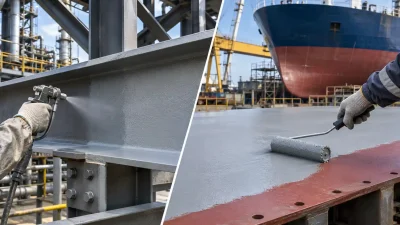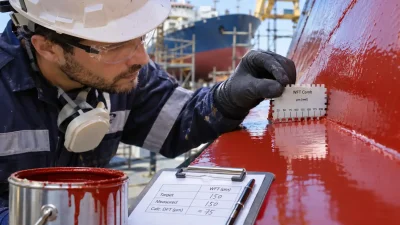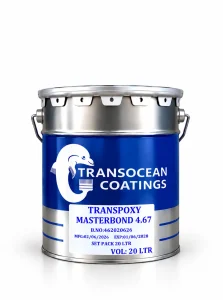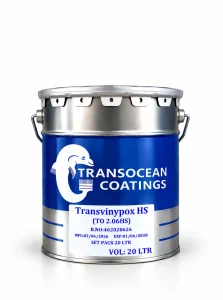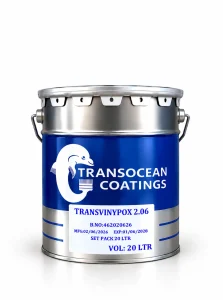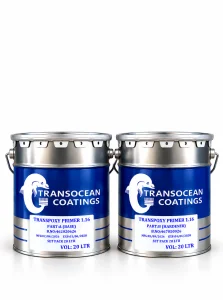


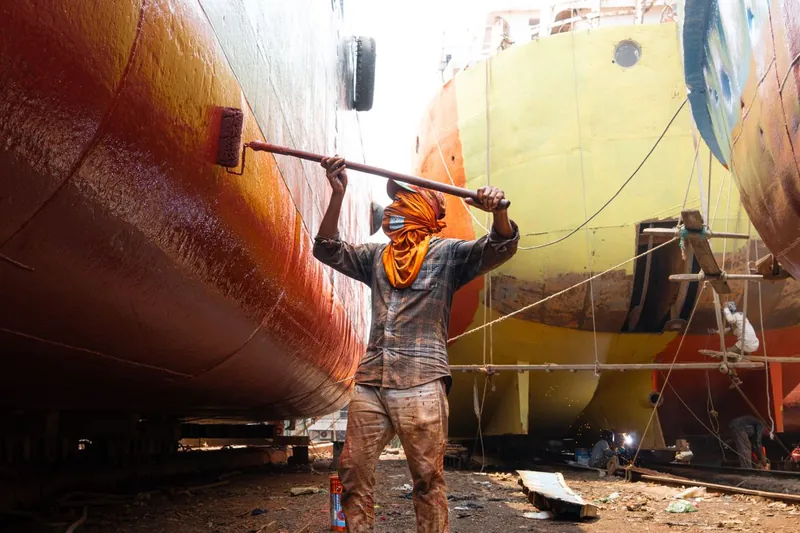
A hull comes into dry dock with old antifouling, sound paint in places and bare steel in others. The superintendent has a short window and a tight budget. Someone suggests a vinyl primer because the yard has always used one. Someone else says epoxy only. Who is right?
This guide is for maintenance managers, ship repair buyers and coating inspectors in the UAE and Oman. It gives an honest view of vinyl primer marine use: what it is, where it still works, where epoxy is the better choice, and how to decide.
What is a vinyl primer marine system and how does it work?
A vinyl primer is a one-pack paint based on vinyl resin. It dries when the solvent evaporates. There is no hardener and no chemical cure. That is why it dries fast and why the film stays soluble in strong solvents.
In ship repair a vinyl primer marine system is used for three jobs:
- Anticorrosive primer on prepared steel, in thin coats.
- Tiecoat between an older system and a new one.
- Sealer over old antifouling before a new antifouling goes on.
The film is thin and flexible. It resists water well. It does not build thick like a two-pack epoxy. For the wider picture of primer families, see our guide to marine primers and anti-corrosive coatings.

Vinyl paint, vinyl tar and chlorinated rubber: the terms explained
Three terms come up in this topic. Keep them apart.
Vinyl paint on a ship hull
Vinyl paint on a ship hull usually means a vinyl-resin system, from primer to antifouling, used on underwater areas. It is valued for fast recoating and for sealing in repair work.
Vinyl tar
Vinyl tar is vinyl resin blended with coal tar. It was common on tanks and underwater steel. Coal tar is a concern for health and environment, so most buyers now ask for tar-free grades. If a specification still names vinyl tar, check owner, class and local rules first.
Chlorinated rubber (history only)
Chlorinated rubber coatings once did similar work to vinyl. Today the topic is mostly historical. Makers and owners have moved to vinyl, acrylic and epoxy products. Treat any old chlorinated rubber coat as an existing system to be identified before overcoating.
Vinyl primer marine use vs epoxy primer: the honest comparison
The honest comparison of vinyl primer marine products with epoxy is a trade-off, not a winner. The table shows the usual pattern. Data sheets decide every real case.
| Point | Vinyl primer | Epoxy primer |
|---|---|---|
| Curing | Solvent evaporation, one pack | Chemical cure, two pack |
| Drying and recoat | Fast, short intervals | Slower, depends on temperature |
| Film build per coat | Thin | Thicker |
| Compatibility with old systems | Often good as a sealer or tiecoat | Needs checking over old vinyl |
| VOC | High solvent content | Usually higher solids, lower solvent |
| Chemical and abrasion resistance | Moderate | Usually higher |
For a deeper look at the epoxy side, read red oxide primer vs epoxy primer.
Drying time, old systems and VOC: what changes the choice
Drying time and recoat
Vinyl films dry by solvent loss, so they dry quickly and can be recoated in a short time. This helps when a dry dock slot is short or the weather turns. Epoxy needs time for the chemical cure, and the cure slows in cool or damp conditions. Always read the recoat window on the data sheet.
Compatibility with old systems
This is where vinyl earns its place. Many old hulls carry vinyl or similar coats. A vinyl primer marine product can seal and bridge them without the risk of lifting the old film. Strong epoxy solvents can soften an old vinyl layer, so test a patch before you commit.
VOC limits
Vinyl paints carry a lot of solvent. Many regions limit VOC in coatings, and vessels working in ports face local rules and ventilation requirements. This is the main driver away from vinyl in new work. Check the VOC figure on the data sheet and the rules at your site.
Where a vinyl primer marine system still works
A vinyl primer marine system still makes sense when speed, sealing and compatibility matter more than film thickness. Typical cases in repair work:
- Sealer over old antifouling. It isolates old paint so a new antifouling can be applied.
- Tiecoat between systems. It helps adhesion between an older coat and a new one.
- Spot repair and touch-up. Fast recoat keeps the schedule short.
- Underwater areas on vinyl-based systems. The new coat matches the existing one.
The TransOcean range includes a product built for these roles. Transvinyl Primer (TO 1.48) is a vinyl-based, tar-free primer. Its product page states that it can be used as a tiecoat on Transpoxy systems, as a standalone anticorrosive system, and as a sealer for old antifouling layers. It is also listed as compatible with TransOcean antifouling systems.
The International Maritime Organization (IMO) regulates antifouling systems under the AFS Convention. This matters when a sealer sits under an antifouling coat.
Where vinyl primer fails and epoxy is the better choice
A vinyl primer marine system is a poor fit when the job needs a high-build film. Choose epoxy, or another high-build system, when the job asks for more than a thin film. Vinyl primer is a poor fit when:
- The area is heavily abraded. Ice, fenders, mooring lines and cargo contact need a harder film.
- Chemical exposure is high. Cargo tanks and spill zones usually call for epoxy-type linings.
- A thick film is required. Vinyl builds in thin coats, so reaching the specified thickness takes many passes.
- VOC limits are strict. A high-solvent paint may not be allowed at the site.
- New-build work with a long-life target. Specifications for these jobs normally name epoxy systems.
For hot, humid Gulf conditions, also weigh the application window. Our zinc rich primer guide shows how another primer family is chosen for steel that needs sacrificial protection.
Surface preparation and application of a vinyl primer marine coat
A vinyl primer marine job fails for the same reasons as any other coating job: salt, moisture, rust and poor preparation. The film is thin, so it hides very little.
- Clean and dry the surface. Remove oil, grease and soluble salts, and keep steel above the dew point.
- Blast or power-tool to the specified grade. Follow the data sheet, not habit.
- Apply thin, even coats. Heavy coats trap solvent and can cause blisters or slow hardening.
- Respect the recoat interval. Over-long gaps can hurt adhesion between coats.
- Ventilate enclosed spaces. Solvent vapour is flammable and harmful to breathe.
In hot Gulf weather solvent leaves quickly. Spray in shade where possible, and watch for dry spray and poor flow. The same data sheet that gives the recoat window also gives the minimum and maximum temperatures for application.
What to ask your supplier before you order
For a buyer, a vinyl primer marine order is simple if the questions are clear. Ask the supplier these before you place the order:
- Which exact system is the primer part of, and what are the tiecoat and finish?
- Is it tar-free, and does it meet the rules of your owner and class?
- What is the recoat interval, and what is the VOC figure?
- Is it approved to go under the antifouling you plan to use?
- Is the technical data sheet available in the language your inspector needs?
Keep the answers with the job file. They help the inspector and protect the owner if a dispute appears later.
How to choose: 5 checks before you order
Use these five checks before you write the order for any vinyl primer marine job.
- Identify the existing coating. Do not overcoat an unknown system without a test patch.
- Define the exposure zone. Underwater, boot-top, topsides, deck or tank.
- Check the target film thickness. Count how many coats a thin vinyl film needs.
- Check VOC and ventilation rules. Include port and yard limits.
- Match the system. Use primer, tiecoat and finish from one maker’s approved system.
Surface preparation decides success whatever the primer. ISO 8501-1 defines the visual rust and preparation grades used in specifications. See also our overview of the marine coating system.
Frequently asked questions
What is a vinyl primer in marine paint?
A vinyl primer is a one-pack coating based on vinyl resin that dries by solvent evaporation. It forms a thin, tough, water-resistant film. On ships it is used as an anticorrosive primer, as a tiecoat between systems, and as a sealer over old antifouling. It does not need a hardener.
Is vinyl primer better than epoxy primer?
Neither is better in every case. Vinyl dries fast, recoats easily and suits thin touch-up and sealing work. Epoxy builds a thicker, harder film and usually performs better in heavy immersion and abrasion. Choose by the exposure zone, the existing system and the paint maker’s data sheet.
Can I apply epoxy over vinyl primer?
Often it is possible, but not always. The strong solvents in some epoxies can lift an old vinyl film, so check the data sheet for the exact products and test a small patch first. Many yards also use a compatible tiecoat. Never assume compatibility on an aged, unknown system.
What is vinyl tar, and is it still used?
Vinyl tar is a vinyl resin blended with coal tar, once common on underwater hulls and tanks. Concern about coal tar has moved most buyers to tar-free grades. If a specification still asks for it, check owner, class and local rules before you buy or apply it.
Why is VOC a problem for vinyl paints?
Vinyl paints are thinned with a lot of solvent, so a large share of the can evaporates as volatile organic compounds (VOC). Many regions limit VOC in coatings. This is one reason some yards switch to higher-solids epoxy systems. Always check local limits and ventilation rules for the job.
Is vinyl primer used on modern ships?
Yes, mainly in repair and maintenance. It is still specified as a sealer over old antifouling, as a tiecoat in some systems and for quick-drying touch-up. New-build and high-performance jobs lean toward epoxy. Follow the system your coating specification and paint maker approve.
Request a quote for a marine vinyl primer
Need a vinyl primer marine option for a sealer, tiecoat or repair job? Open the Transvinyl Primer (TO 1.48) product page and send a quote request with your area, surface and site. You can also browse the TransOcean paint range or contact our team for help matching the primer to your existing system.