


A ship arrives at the berth in the morning and sails at night. The chief officer finds corroded patches on deck, the paint locker is nearly empty, and the next port is days away. Without a clear plan for sea stock marine paint supply, that small problem turns into rust, delay and an expensive repair later.
This guide is for ship chandlers, purchase managers and superintendents who order coatings for vessels in the UAE and Oman. It explains what sea stock is, how it differs from dry dock supply, what to order, which documents to ask for, and how to run the RFQ in six clear steps.
What sea stock marine paint supply means
Sea stock means the paint and related materials that a vessel holds on board for maintenance during normal trading. The crew uses them between dockings: touching up the deck, the hatch coamings, the superstructure, the pipework and the boot-top. Sea stock marine paint supply is the service of delivering these materials to the ship while she is in port or at anchor.
The buyer is often a ship chandler or the ship’s owner and manager, who orders through the vessel’s agent. The goods may go to the berth, an anchorage by launch, or a bonded store. The details depend on the port.
- Who orders: the superintendent, the purchase department or a chandler acting for the ship.
- Who uses: the deck crew, in small and repeated jobs.
- When: in the days before arrival, or during the port stay.
The term chandler comes from the old trade of supplying ships. You can read the general background on ship chandlers if you are new to the business.

Sea stock marine paint supply vs dry dock and ship repair
Buyers often mix up the two. Both involve paint and ships, but the job is not the same. Sea stock marine paint supply serves the crew. Dry dock supply serves a yard that coats the hull for a planned repair period.
| Point | Sea stock | Dry dock / ship repair |
|---|---|---|
| User | Ship’s crew | Yard or contractor |
| Typical use | Touch-up and routine maintenance | Full hull, tank or deck systems |
| Order size | Small to medium | Large, planned in advance |
| Timing | Short port stay | Repair period set by the project |
| Delivery | Berth, anchorage or agent | Yard store or dock side |
Both can be linked. A vessel may take sea stock for deck work in Dubai and then need a full coating system at a yard in Duqm. Our guides to ship repair coatings in Duqm and the ASYAD drydock paint supplier cover the yard side in detail.
What paint and how much vessels order for sea stock
Sea stock lists differ by ship type, age and trade. A tanker, a bulk carrier and a container ship will not order the same items. Still, a typical list follows the areas the crew coats in service.
- Primers and anticorrosive coats for rust spots on deck, hatch covers and structures.
- Topcoats in the colours of the vessel, such as deck, hull and accommodation colours.
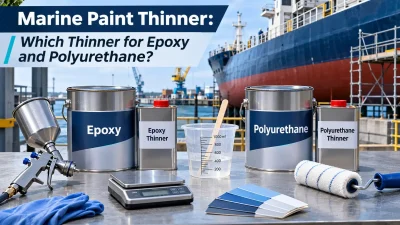
- Thinner and cleaner that match each paint system.
- Touch-up products for small damaged areas of the hull above the waterline.
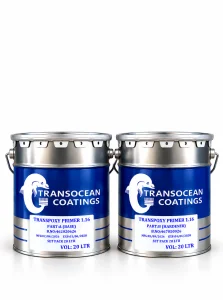
- Hardeners and curing agents for two-pack paints, which must be supplied in the right ratio.
Never order a hardener alone or from another batch family. Two-pack paint works only with its own matching hardener.
How to estimate the quantity
Use the same logic as any coating job. Take the area, the target dry film thickness (DFT) and the volume solids of the paint. Then add loss.
Theoretical litres = area × DFT ÷ (volume solids × 10), with DFT in microns and volume solids in percent.
Example, with round figures for illustration only: a 200 m² touch-up at 120 µm DFT with a paint of 60% volume solids needs 200 × 120 ÷ 600 = 40 litres in theory. With 30% loss in application, the order is about 57 litres. Always take the real numbers from the data sheet. Our guide to marine paint consumption explains the loss factors in more detail.
The ship also keeps a spare quantity. A reasonable spare depends on the next port and on how often the crew paints. The superintendent should decide this, not the supplier.
Documents to ask for with every sea stock paint order
Paint is a regulated product. A good sea stock marine paint supply order is not only cans: it comes with paper that the ship can show to the master, the port and the inspector.
- Technical data sheet (TDS): gives the application data, the DFT, the volume solids, the drying times and the shelf life. Read our guide to the marine coating technical data sheet to see what to check.
- Safety data sheet (MSDS/SDS): required for storage and handling on board. See the general description of a safety data sheet.
- Batch number and date: printed on the can and needed for traceability and shelf-life checks.
- Packing list and invoice: match the products and quantities to the RFQ, and often needed for port and customs entry.
- Certificates: only if the ship, the class or the owner requires them. State this in the RFQ, and ask the supplier to confirm what it can provide.
Do not assume a certificate exists. Ask in writing, before the order is confirmed.
Logistics and delivery time in port
Time is the hardest part of sea stock. The ship does not wait. The order must reach the vessel inside the port stay, with the right paperwork, at the right gate or quay.
Plan these points as early as you can:
- Arrival and departure dates. Share them with the supplier and update them if the schedule moves.
- Delivery point. Quayside, anchorage launch or the agent’s store. Ports differ in access rules.
- Agent contact. The vessel’s agent usually coordinates gate passes and boarding.
- Hazardous goods. Paint is a flammable product and moves under dangerous-goods rules. Ask the supplier how the shipment will be packed and documented.
- Customs and port conditions. Check what the port and your shipping line require before you confirm the delivery date.
We do not promise a fixed delivery time here, because it depends on the product, the stock position and the port. Ask the supplier to confirm a date in the quotation. Our dry dock and port-side pages, such as marine coating supplier Duqm Oman, show the ports we serve.

Packaging and shelf life in hot-climate ports
A ship in the Gulf keeps its paint in heat. Cans may sit for months in a paint locker on deck or in a store room. Packaging and shelf life matter more here than in a cool climate.
- Check the shelf life on the data sheet. It is given for storage in a cool, shaded place, with the can sealed.
- Check the batch date on arrival. Refuse stock that is already close to the end of its shelf life, unless the ship will use it at once.
- Inspect the packs. Cans should be sealed, undamaged, not swollen and not rusted.
- Store correctly on board. Keep cans sealed, off direct sun, away from heat and ignition sources, and in the paint locker.
- Rotate the stock. Use the older batch first.
Our article on marine paint shelf life in hot climates gives practical storage tips, and the next section shows how to put all of this into the order.
The sea stock RFQ process in 6 steps
A clear request saves hours. Follow these six steps for a sea stock RFQ.
- Identify the ship and the port. Give the vessel name, the IMO number, the port, the berth or anchorage, and the agent.
- Set the dates. State the arrival, the departure and the last date for delivery on board.
- List the products. Use the product name, the colour, the system and the pack size. Add the hardener and thinner for each paint.
- State the quantities. Use the calculation above and the spare policy of the owner.
- List the documents. Ask for the TDS, SDS, packing list, batch details and any certificate that the ship needs.
- Confirm the delivery terms. Agree the delivery point, the contact person, the payment terms and the way the goods will be handed over.
Send the request in one message, with the details in a list. The supplier can then answer with a quotation, a product match and a delivery date, rather than ask you five questions.
Common mistakes in sea stock orders
These mistakes cause most problems with sea stock marine paint supply:
- Ordering too late. A request sent on the day of arrival leaves no time for paperwork.
- Missing hardener or thinner. The paint cannot be used without them.
- Wrong colour or system. Always give the full product name, not only “grey primer”.
- No documents. The ship may be unable to show the SDS or the batch details when asked.
- Ignoring shelf life. Old stock in a hot locker can be unusable when the crew opens it.
- Mixing up sea stock and dry dock. The two orders have different sizes, users and timing.
Frequently asked questions
What is sea stock marine paint supply?
Sea stock marine paint supply is the delivery of paint, thinner and related coating materials to a ship that is in port or at anchor. The crew uses them for maintenance on board while the vessel trades. It is different from dry dock supply, where the yard applies the paint during a repair period.
How is sea stock different from dry dock paint supply?
Sea stock serves the ship’s own crew, in small to medium quantities, for touch-ups and routine maintenance. Dry dock supply serves a repair yard or contractor, in large quantities, for full hull or tank coating systems. The order size, the timing and the paperwork are usually different.
Which documents should come with a sea stock paint order?
Ask for the technical data sheet (TDS) and the safety data sheet (MSDS/SDS) for every product, plus the batch number and the shelf life on each pack. If the ship’s class or owner requires a certificate, say so in the RFQ and ask the supplier to confirm what is available.
How much paint should a vessel order for sea stock?
Start from the area to be coated, the dry film thickness (DFT) in the specification and the volume solids of the paint. Calculate the theoretical litres, then add an allowance for loss and for a spare quantity. The chief officer or superintendent should approve the final quantity.
How long can paint stay on board in hot weather?
It depends on the product and on the storage place. The maker’s data sheet states a shelf life for storage in a cool, shaded area. Heat shortens usable life, so keep cans sealed, off direct sun and away from heat sources. Check the batch date and the paint condition before use.
What should I include in a sea stock RFQ?
Include the vessel name and IMO number, the port and berth, the agent contact, the expected arrival and departure dates, the product names and colours, the pack sizes and quantities, and the documents needed. Add the delivery point and any customs or port-access conditions.
Request a quote for sea stock marine paint supply
Planning sea stock marine paint supply for a vessel in Dubai or Duqm? Browse the TransOcean marine paint range in our shop and send your quote request with the vessel, the port, the products and the dates. You can also contact our team. Our office is at Office 36, Building 10, Bay Square, Business Bay, Dubai. Call +971 4 313 2379 or +971 56 381 3811, or message us on WhatsApp at +971 50 910 3430.