

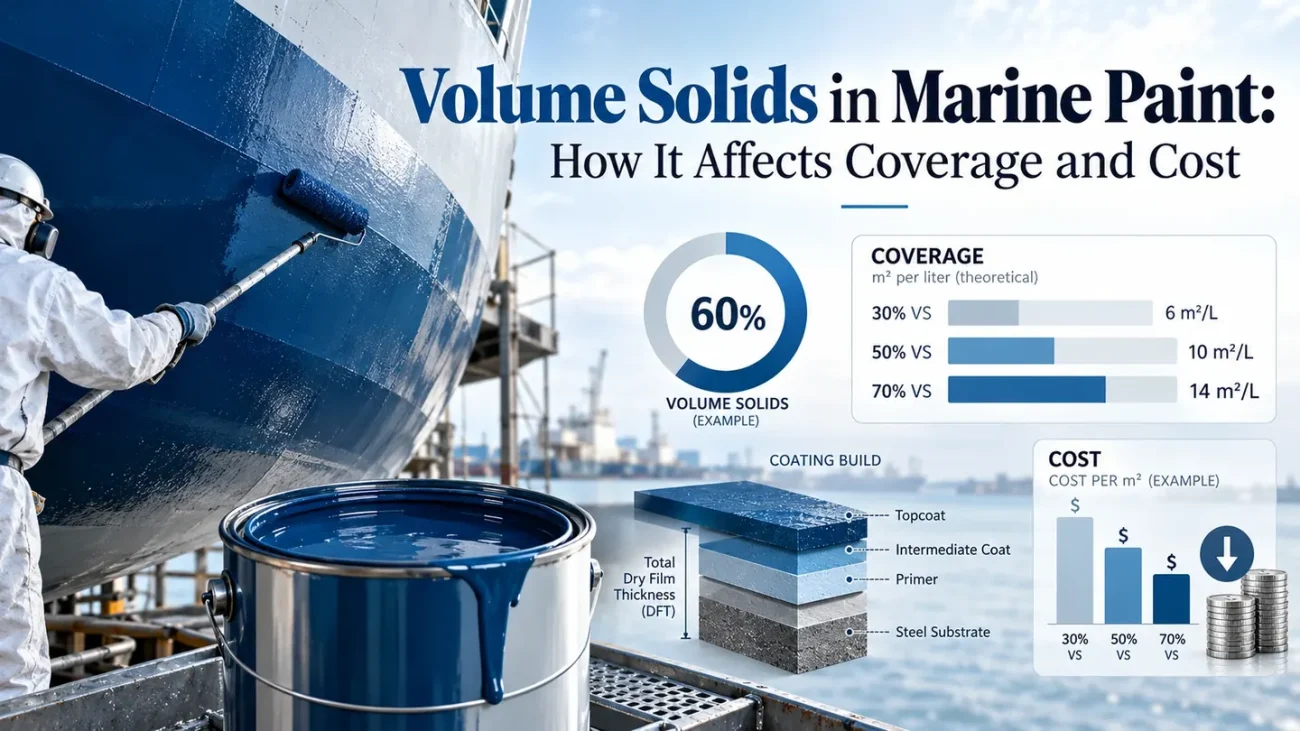
Two paint quotes arrive with different prices per litre. Which one is cheaper? You cannot tell from the price alone. The answer depends on how much of each litre stays on the steel as dry film.
This guide is for procurement officers, superintendents and estimators who compare marine paint offers. You will learn what volume solids in marine paint means, how to turn it into coverage and cost per square metre, which losses to add, and where to find the figure on the data sheet.
What is volume solids in marine paint?
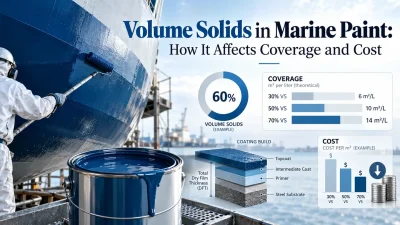
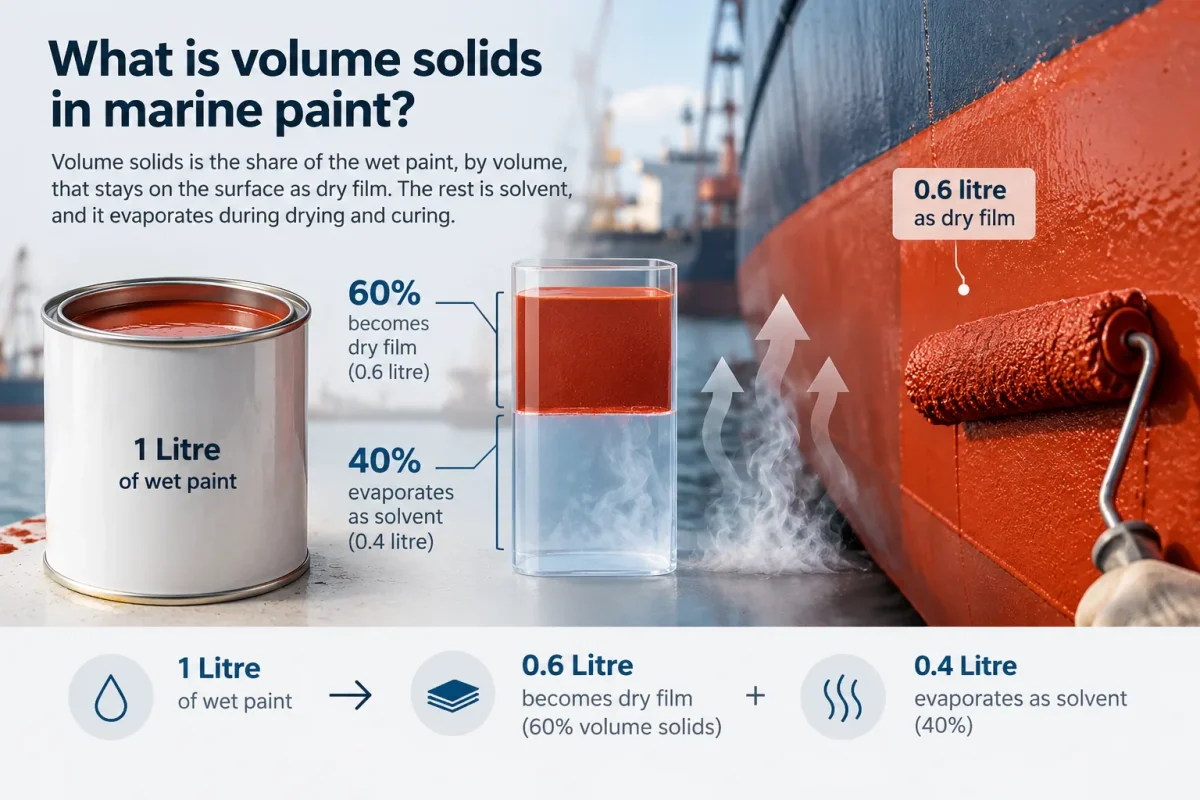
Volume solids in marine paint is the share of the wet paint, by volume, that stays on the surface as dry film. The rest is solvent, and it evaporates during drying and curing. Data sheets give the figure as a percentage, for example 60%.
Think of one litre of wet paint. At 60% volume solids, 0.6 litre becomes the dry film and 0.4 litre leaves as solvent. The higher the figure, the more film you get from each litre you pay for.
Volume solids is not the same as solids by weight. Weight solids depend on how heavy the pigments are, so they say little about the film you build. Coverage is a question of volume, so always use the volume figure.
The theoretical coverage formula: m2 per litre
Theoretical coverage is the area one litre can cover at a chosen dry film thickness (DFT), with no losses. The standard formula is:
- Theoretical coverage (m2/L) = 10 x volume solids (%) / DFT (microns)
- Wet film thickness (microns) = DFT x 100 / volume solids (%)
The factor 10 comes from unit conversion. One litre spread to a film 1 micron thick covers 1,000 m2, so the formula only needs the volume solids percentage and the film thickness.
Here is the basic worked example:
- Volume solids: 60%
- Target DFT: 100 microns
- Theoretical coverage: 10 x 60 / 100 = 6 m2 per litre
- Wet film needed: 100 x 100 / 60 = about 167 microns
- Paint for 10 m2: 10 / 6 = about 1.67 litres
Double the DFT and you halve the coverage. At 200 microns the same paint gives 10 x 60 / 200 = 3 m2 per litre. This is why dry film thickness and volume solids in marine paint must always be read together. Our guide to marine coating DFT and film thickness inspection explains how the film is measured on the job.
Why a cheaper litre can cost more per square metre
The price per litre does not show the cost of protecting a square metre, but volume solids in marine paint does. Cost per square metre of paint equals the price per litre divided by the coverage in m2 per litre. Compare two offers at the same DFT, from the same system.
Take two epoxy offers for a 200 micron coat. The prices are examples only, not real quotes.
- Paint A: 50% volume solids, price 4.00 per litre. Coverage = 10 x 50 / 200 = 2.5 m2 per litre. Cost = 4.00 / 2.5 = 1.60 per m2.
- Paint B: 70% volume solids, price 4.80 per litre. Coverage = 10 x 70 / 200 = 3.5 m2 per litre. Cost = 4.80 / 3.5 = 1.37 per m2.
Paint B costs 20% more per litre, yet it is about 14% cheaper per square metre. Paint A looks cheap on the quote and costs more on the hull.
The gap also reaches logistics. Paint B needs fewer litres for the same area, so there are fewer pails to order, ship, store and dispose of. Add this to the comparison when freight to the yard is part of the budget. Ask for the data sheet of each product in the TransOcean marine paint range before you compare.
Practical loss factors: profile, overspray and wastage
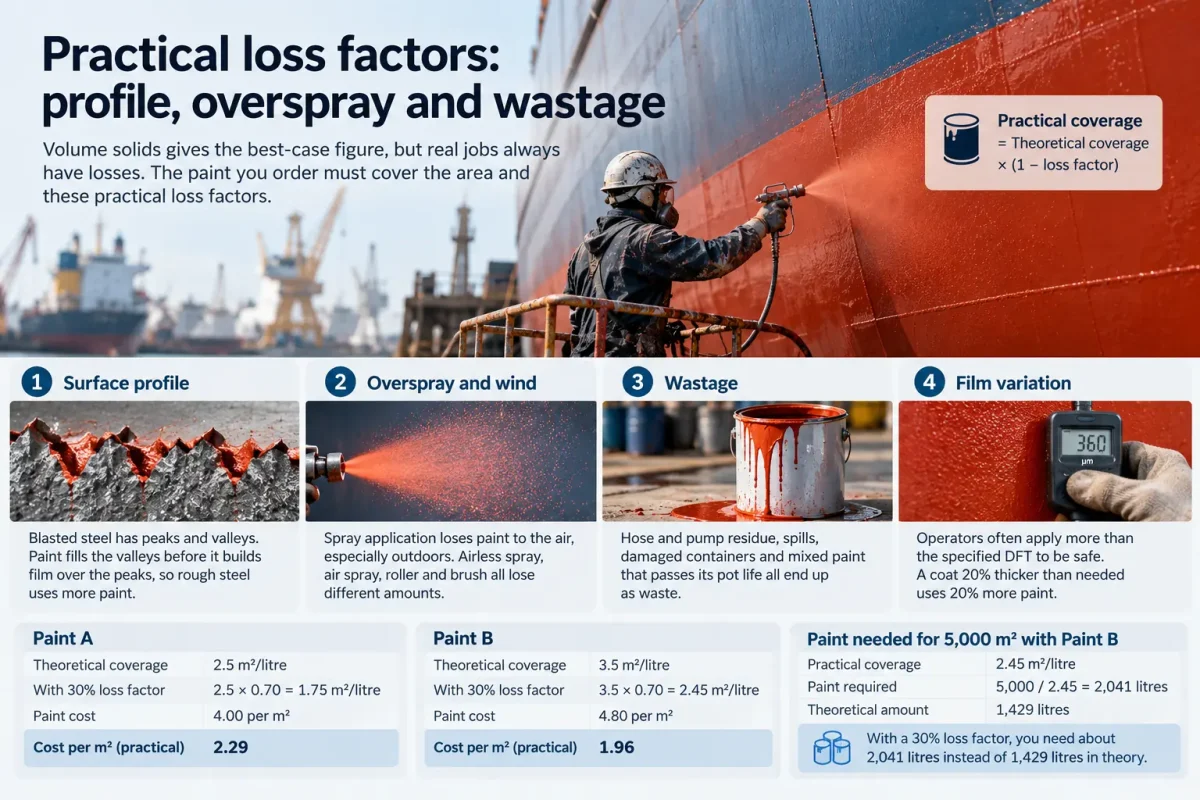
Volume solids in marine paint gives the best-case figure, and no job reaches the theoretical figure. The paint you order must cover the area and the losses. The practical coverage is the theoretical coverage multiplied by (1 – loss factor). Four groups of loss matter most.
- Surface profile. Blasted steel has peaks and valleys. Paint fills the valleys before it builds film over the peaks, so rough steel uses more paint. Many data sheets show the profile range the figure assumes.
- Overspray and wind. Spray application loses paint to the air, especially outdoors and on open structures such as a hull side. Airless spray, air spray, roller and brush all lose different amounts.
- Wastage. Hose and pump residue, spills, damaged containers and mixed paint that passes its pot life all end up as waste. Mix only what the crew can apply in time.
- Film variation. Operators often apply more than the specified DFT to be safe. A coat 20% thicker than needed uses 20% more paint.
Here is the earlier example with an assumed loss factor of 30%. Replace this figure with the record of your own yard and method.
- Paint A: 2.5 x 0.70 = 1.75 m2 per litre, so 4.00 / 1.75 = 2.29 per m2
- Paint B: 3.5 x 0.70 = 2.45 m2 per litre, so 4.80 / 2.45 = 1.96 per m2
- Paint needed for 5,000 m2 with Paint B: 5,000 / 2.45 = about 2,041 litres, against 1,429 litres in theory
The loss factor lowers both paints, so the ranking stays the same. For a method to estimate quantities for a whole vessel, read how much paint a ship needs.
Where to find volume solids on the data sheet
Find volume solids in marine paint in the technical data block of the product data sheet. It normally sits near these lines:
- Volume solids, in % by volume, for the mixed product
- Recommended dry film thickness, as a range or a single value
- Theoretical spreading rate, in m2 per litre at a stated DFT
- Thinner type and the maximum thinning percentage
- Mixing ratio and pot life
The figure is usually found by a laboratory method. A common one is ASTM D2697, the test method for volume nonvolatile matter in coatings. The ISO 3233 series covers the same idea. If a data sheet names its method, you can compare figures from different makers more fairly.
Check also that the stated volume solids matches the theoretical spreading rate. Put the DFT and the volume solids in the formula. If the result differs from the printed coverage, ask the supplier why. For a full walk through the sheet, see our guide to reading a marine coating technical data sheet.
Two more points help. Volume solids can vary between colours of the same product, so check the line for the colour you need. And always use the current data sheet for the product, not an old copy.
How to compare paint quotes in 5 steps
Use the same five checks for every offer. They keep a quote comparison fair and quick to audit.
- Same system and DFT. Compare paints for the same coat at the same dry film thickness from the specification.
- Get volume solids in marine paint from the data sheet. Do not accept a number from a sales message.
- Calculate coverage. Use 10 x volume solids / DFT for every paint.
- Add your loss factor. Use the same one for every offer, based on your own records.
- Divide the price. Cost per square metre = price per litre / practical coverage. Rank the offers on this figure, then check delivery and technical support.
The paint must still meet the project specification first. Our article on the marine coating specification shows what the spec should state so that offers are truly comparable.
Frequently asked questions
What does volume solids in marine paint mean?
Volume solids is the percentage of the wet paint volume that remains on the surface as dry film after the solvent has left. A paint with 60% volume solids leaves 0.6 litres of dry film from every litre applied. It is the main number behind coverage and cost per square metre.
How do you calculate theoretical coverage from volume solids in marine paint?
Theoretical coverage in m2 per litre equals 10 times the volume solids percentage divided by the dry film thickness in microns. For example, 60% volume solids at 100 microns gives 10 x 60 / 100 = 6 m2 per litre. It assumes no loss, a smooth surface and a perfectly even film.
Is higher volume solids in marine paint always better?
Not always. A higher figure gives more dry film per litre and usually lower solvent emissions, but the product must still suit the surface, the system and the application method. Compare volume solids only between paints that meet the same specification, then judge the price per square metre.
Where do I find volume solids in marine paint on a data sheet?
Look in the technical data section of the product data sheet, near the recommended dry film thickness and the theoretical spreading rate. It is usually shown as a percentage by volume for the mixed product. Check the test method and the date of the data sheet before you use the figure.
Why is practical coverage lower than theoretical coverage?
Theoretical coverage assumes zero loss. In real work paint is lost to the blast profile, overspray, wind, hose and pump residue, uneven film, spills and leftover mixed paint. The loss factor changes with the surface, the method and the job, so estimators should use their own records.
Does thinning change the volume solids of a paint?
Yes. Added thinner is extra solvent that leaves the film, so the mixed paint holds fewer solids per litre and covers less area at the same dry film thickness. Add thinner only within the limit on the data sheet and use the thinner the maker names for the product.
Get paint quotes you can compare
Comparing marine paint offers for a vessel or a steel structure in the UAE or Oman? Request a quote for TransOcean marine paints and tell us the system, the area and the target DFT. Our team will send the data sheets so you can check volume solids and cost per square metre yourself. For other questions, contact us.