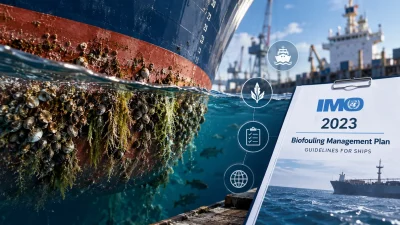


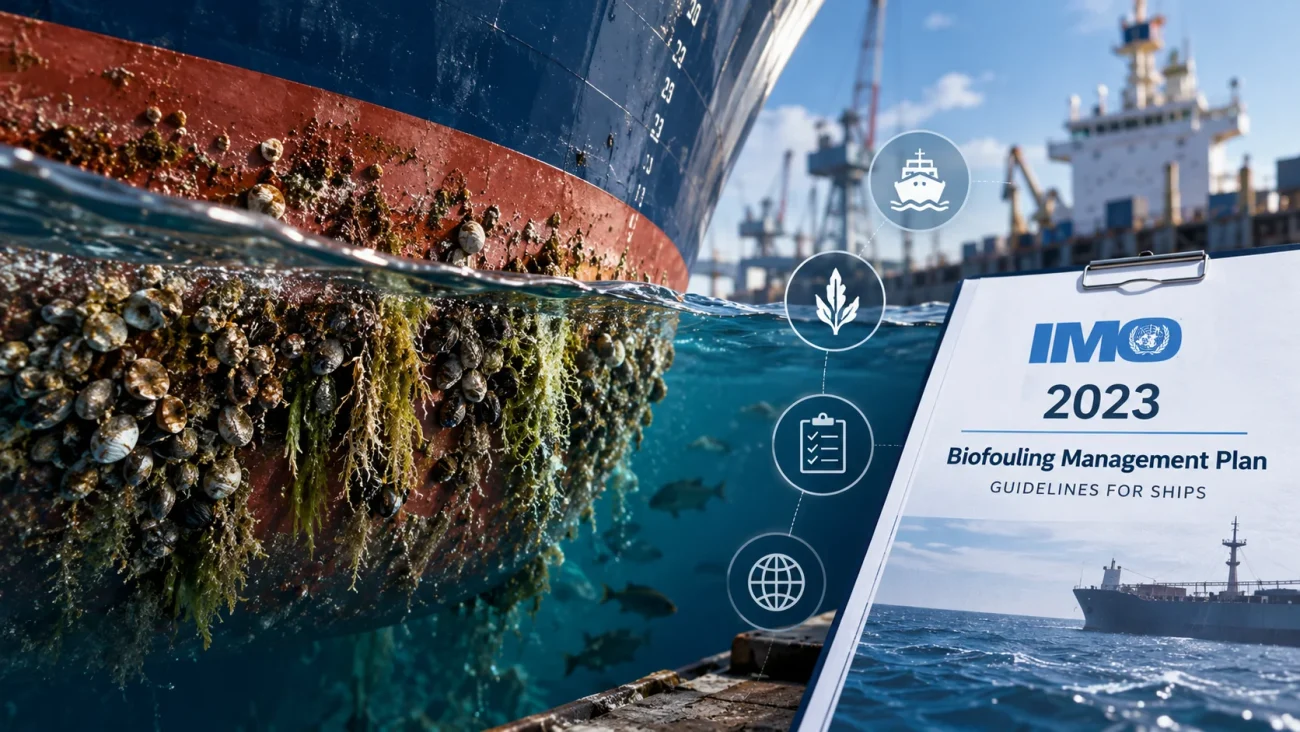
Hull fouling costs fuel, speed and port access. It can also carry invasive aquatic species from one coast to another. For this reason, regulators and charterers now ask owners to prove that fouling is controlled, not just to buy a good coating.
A biofouling management plan is the document that proves it. This guide explains the plan and the biofouling record book under the IMO 2023 guidelines. It is written for ship owners, superintendents and technical managers working with UAE and Oman ports.
What is a biofouling management plan?
A biofouling management plan is a ship-specific document that explains how the hull, propeller and sea chests are protected against fouling. It names the antifouling system, the inspection and cleaning methods and the person in charge. Alongside it, the biofouling record book logs each action taken on the hull. Together they show that fouling control is planned and checked.
What changed in the IMO 2023 biofouling guidelines
The IMO biofouling guidelines 2023 replaced the 2011 guidelines. The aim is unchanged: to reduce the transfer of invasive aquatic species through hull fouling. The new text updates the advice on the plan, the record book, inspection, cleaning and in-water cleaning, and gives clearer templates.
Two points matter for owners:
- The guidelines are recommendatory at IMO level. Some coastal states turn them into local requirements, so check each port on your route.
- Old plans need review. A plan written for the 2011 text should be compared with the 2023 guidelines and updated.
Read the official IMO page on biofouling for the current text. This is separate from the AFS Convention, which controls the antifouling paint itself. Our guide on the IMO AFS Convention and the TBT ban covers that part.
What a biofouling management plan should contain
The plan should be short, practical and written for this ship, not copied from a template. A good biofouling management plan has these parts.
Ship details and responsible person
Start with the ship particulars, the trading area and the operating profile. Name the person responsible for biofouling management on board and ashore. Add the date of the last review. The profile should show speed, port time and typical idle periods, because slow and idle ships foul faster.
Antifouling system and niche areas
Describe the antifouling system: paint type, supplier, film thickness, application date and the expected service life. Then list the areas where fouling starts first. These niche areas include sea chests, bow thrusters, rudder and stabiliser recesses, propeller and shaft, and dry-docking support strips.
These places often get less paint film and less water flow. The biofouling management plan should state how each one is protected and checked.
Inspection, cleaning and maintenance procedures
Set out how and when the hull is inspected, who does it and what is done if fouling is found. Include the method for cleaning, the limits for in-water cleaning, and the rules for waste. In-water work must follow the port and flag state rules, and it should capture debris wherever the rules ask for it. Add safety measures for divers and crew, and a short training note.
The biofouling record book: what to record
The biofouling record book is the working log of the plan. If the plan says what should happen, the record book shows what did happen. Keep it on board, make entries on the day and have each one signed.

A useful biofouling record book includes:
- Dry-docking dates, work done and coating details.
- Antifouling system and any marine growth prevention system in use.
- Hull and niche area inspections, with findings and photos.
- Cleaning events, method used and where they took place.
- Repairs and spot touch-ups to the coating.
- Long idle periods, slow steaming and unusual trading.
- Name and signature of the person making each entry.
Treat the biofouling record book like the oil record book: a missing page costs more than the time spent filling it in. Inspectors and charterers read it first.
How the biofouling management plan links to antifouling choice
The plan is only as good as the coating behind it. Choose the antifouling for the real trading pattern of the ship. Our guide on antifouling paint types compares self-polishing and hard matrix systems, and shows which suits slow or fast ships.
The biofouling management plan should also record why the coating was chosen. If you need a refresher on the basics, read what antifouling coatings are and why they matter. A biofouling management plan that says only “antifouling applied” gives an inspector nothing to check.
Link the coating life to the docking cycle. When the paint reaches the end of its service life, the plan should trigger an inspection and a decision between a spot repair and a full recoat. Our article on spot repair vs full recoat explains how to decide.
Inspection and cleaning schedule for UAE and Oman ports
Warm water speeds up fouling. Ships calling at Gulf ports in the UAE and Oman should expect faster growth during idle periods and long port stays. The inspection schedule in your biofouling management plan should reflect this.
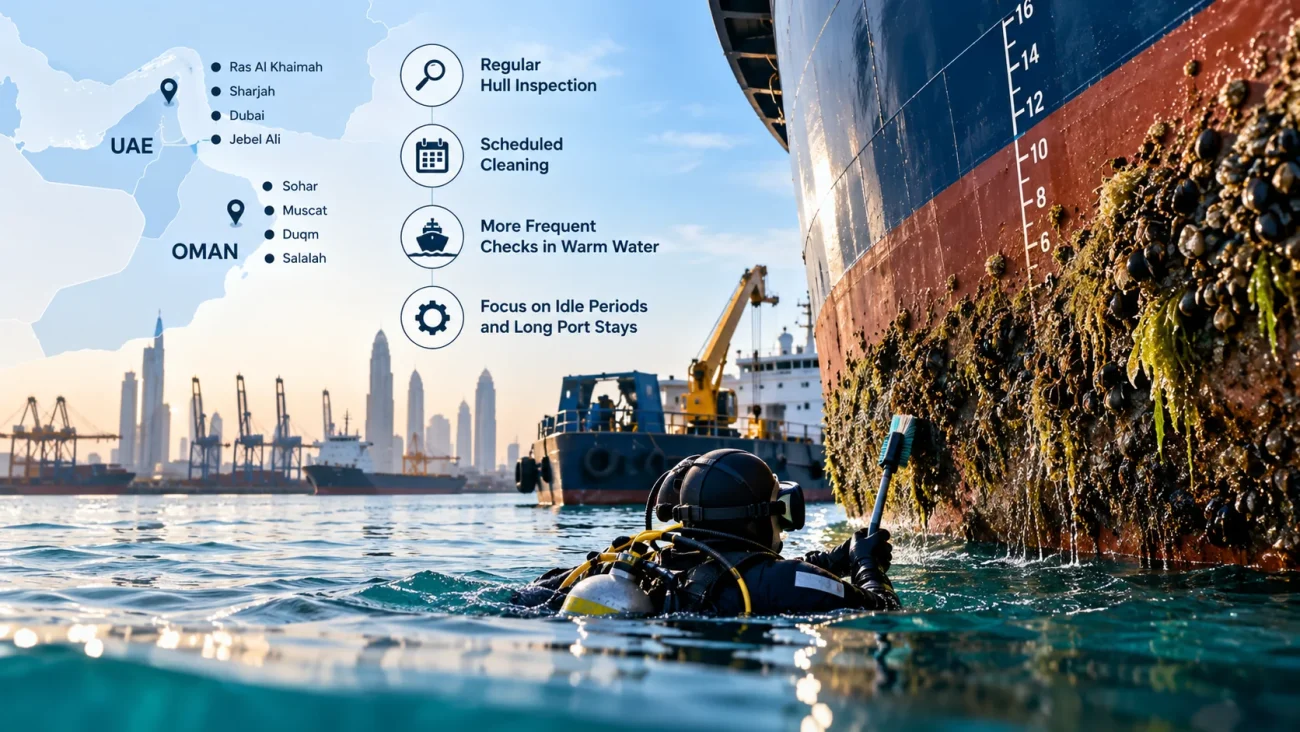
A simple schedule works well:
- At every dry-docking: full hull, propeller and niche area inspection, with a record entry.
- Between dockings: in-water inspection at an interval set in the plan.
- After idle periods: inspect before sailing, as set by the plan trigger.
- After damage or coating repair: inspect and record the repair.
Dry-docking is the best time for hull biofouling control because the whole surface can be seen and measured. Use that visit to check the antifouling system maintenance items in the plan, such as paint condition, thickness and the state of the propeller polish.
7 steps to prepare your biofouling management plan
Use this checklist to write or update a biofouling management plan.
- Collect ship data: particulars, speed profile, trading area and idle time.
- Describe the coating: product, system, date and service life from the data sheet.
- Map niche areas: list every place where fouling starts first.
- Set inspection intervals: dry-dock and in-water checks with triggers.
- Define cleaning rules: methods, limits and port approvals.
- Assign people: name the responsible person and train the crew.
- Start the record book: begin entries on the day the plan is approved.
Review the biofouling management plan once a year and after each docking, a coating change or a change in trade. Revision dates belong in the plan itself.
Common biofouling management plan mistakes
Owners often lose the benefit of a good coating through avoidable gaps in the plan:
- Generic text. A template with no ship data does not help the crew.
- No niche area list. Sea chests and thrusters are forgotten.
- Late entries. The record book is filled in weeks later from memory.
- No review. The plan still shows the old paint after a recoat.
- Unapproved cleaning. In-water cleaning without port permission.
Keep the biofouling management plan alive and the record honest, and most of these problems disappear.
Frequently asked questions
What is a biofouling management plan?
A biofouling management plan is a ship-specific document that describes how hull fouling is controlled. It lists the antifouling system, the areas prone to fouling, the inspection and cleaning procedures, the responsible person and the safety measures. It is kept on board and updated when the coating or operation changes.
Is a biofouling management plan mandatory?
The IMO guidelines are recommendatory, so the plan is not an IMO convention requirement. However, some coastal states ask for biofouling documents on arrival. Charterers may also ask for them. Check the rules of every port on your trading route before relying on the IMO status alone.
What did the IMO 2023 biofouling guidelines change?
The 2023 guidelines replaced the 2011 guidelines. They were adopted by the IMO Marine Environment Protection Committee in 2023 and update the advice on the plan, the record book, inspection, cleaning and in-water cleaning. Ship owners should align older plans with the new text.
What goes in a biofouling record book?
The record book logs every action that affects hull fouling. Typical entries are dry-docking dates, antifouling system details, in-water inspections, cleaning events, repairs, long idle periods and the person who signed each entry. The record shows an inspector how the plan was applied in practice.
How often should a hull be inspected for biofouling?
The plan sets the interval for your ship. Many owners inspect at every dry-docking and add in-water inspections between dockings, especially after idle periods or trading in warm water. The right interval depends on the antifouling type, the speed and the trading pattern.
Who is responsible for the biofouling management plan on board?
The ship owner or operator is responsible, and the plan should name the person in charge of biofouling management. This is usually the master with the technical superintendent ashore. Crew who carry out inspections need training in the plan and in the correct way to fill in the record book.
Get the right antifouling for your next dry-docking
Preparing a biofouling management plan for your next docking? Start with the coating data. Request a quote for Transocean Cleanship 295 (TO 2.95) and send us the ship type, hull area, trading pattern and dry-dock dates. Our team will help match the product, the quantity and the data sheet you need for the plan. You can also browse the full antifouling range.