

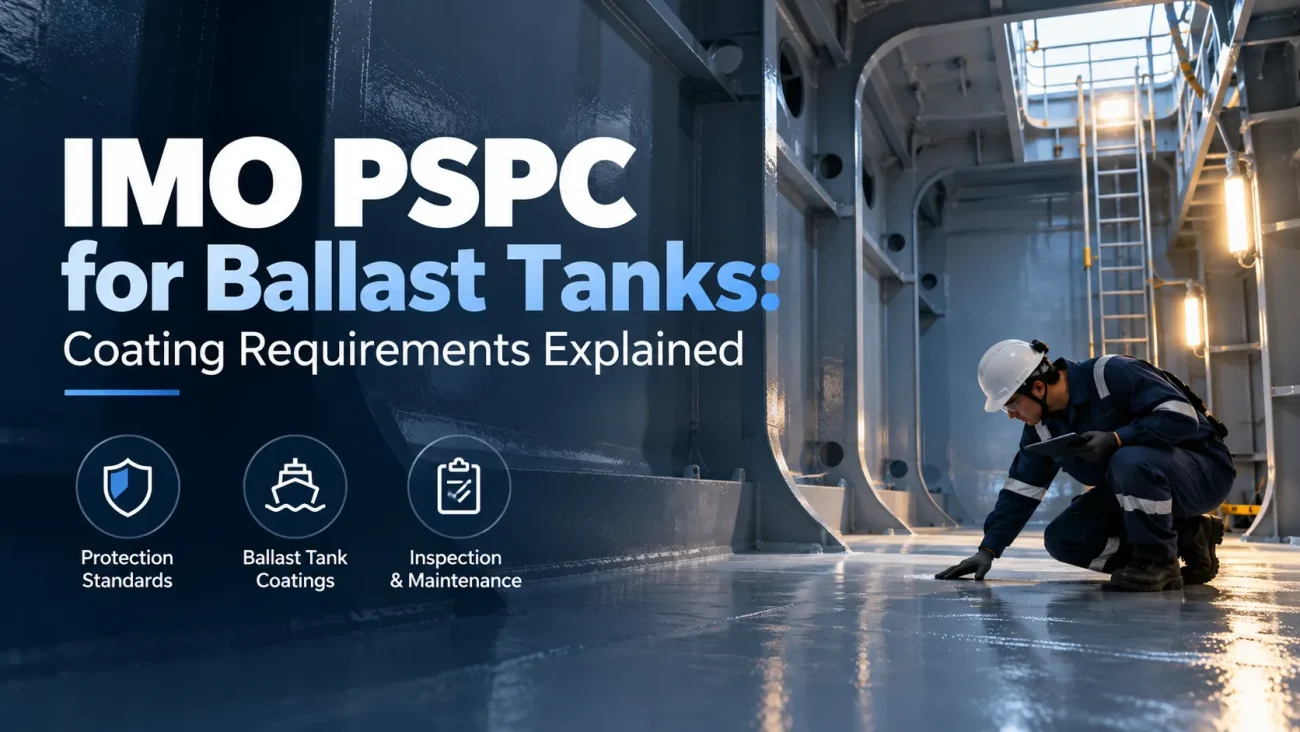
A newbuild tanker is weeks from delivery, and the ballast tanks are the last big paint job. The owner wants 15 years of protection. The yard wants to keep the schedule. The paint maker wants records. Who decides what counts as a proper job? The answer is a single IMO rule that every party must follow.
This guide explains IMO PSPC ballast tanks rules in plain language. It is written for technical managers, paint buyers and coating contractors who work with ships in the UAE and Oman.
IMO PSPC ballast tanks: the short answer
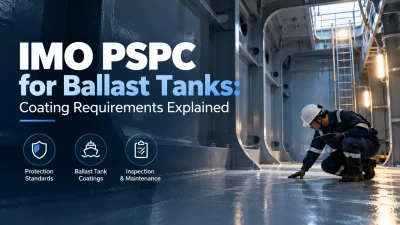
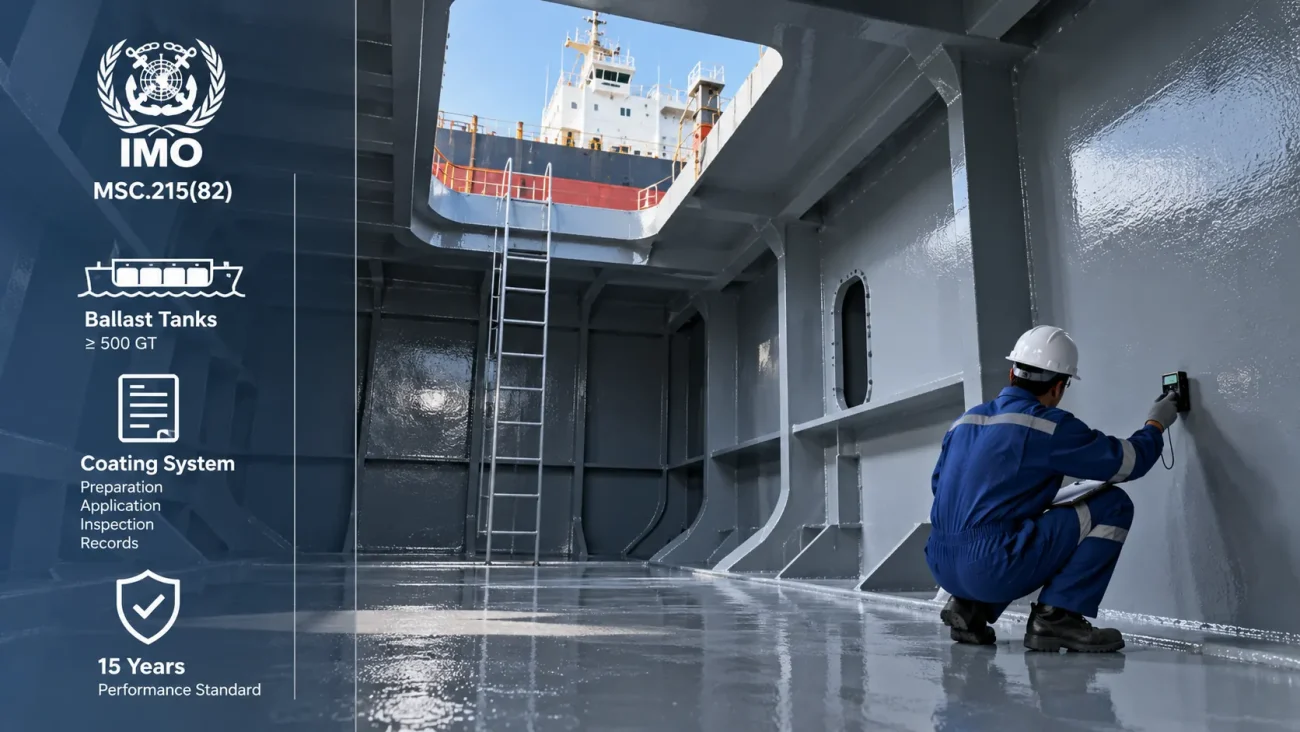
PSPC stands for Performance Standard for Protective Coatings. It is IMO resolution MSC.215(82), adopted in December 2006. It is made mandatory through SOLAS regulation II-1/3-2. The standard aims for a coating that stays in good condition for 15 years.
- Where it applies: dedicated seawater ballast tanks on new ships of 500 gross tons and above.
- Also covered: double-side skin spaces on bulk carriers.
- What it controls: the coating system, steel preparation, application, inspection and records.
- The proof: a Coating Technical File that stays on board.
Why the IMO set a standard for ballast tank coatings
A ballast tank holds seawater. It sits next to hot cargo or a hot engine room, then it is emptied and dried again. Steel in this setting corrodes fast. You can read how ballast works in this overview of ballast tanks.
Corrosion weakens the hull, and tank repairs are slow and costly. Before IMO PSPC ballast tanks rules, coating quality varied from yard to yard. The IMO set one common performance standard so that ballast tank coatings are chosen, applied and checked the same way worldwide.
Our guide to ballast tank coatings and corrosion protection covers the wider topic. Here we focus on the rule itself.
Which ships and tanks fall under IMO PSPC ballast tanks rules
The scope of IMO PSPC ballast tanks rules follows the SOLAS text. It covers dedicated seawater ballast tanks in all types of ship of 500 gross tons and above. It also covers double-side skin spaces in bulk carriers. The dates depend on contract, keel laying and delivery, so confirm them for your ship with the class society.
Three points surprise buyers:
- PSPC is a newbuilding standard. Repairs on older ships follow class rules and good practice.
- Cargo tanks are outside this standard. Crude oil tanker cargo tanks have a separate one, MSC.288(87).
- Your ship may carry extra class notations. Check the full class rules, not just the IMO text.
For cargo tank choices, read our guide to cargo tank coatings on chemical tankers.
PSPC coating requirements at a glance
Here are the main PSPC coating requirements in one view. The text of MSC.215(82) and its amendments is the final authority. Read the original on the IMO protective coatings page.
| Area | What PSPC asks for |
|---|---|
| Coating system | Epoxy-based system, type approved, tested by the paint maker |
| Film thickness | Nominal total dry film thickness of 320 microns, using the 90/10 rule |
| Coats | Two spray coats, plus two stripe coats on edges, welds and corners |
| Steel preparation | Blast cleaning to Sa 2.5 with a 30 to 75 micron profile |
| Cleanliness | Soluble salts limited to 50 mg/m2, and dust rated 1 or better |
| Edges | Rounded edges, with a minimum radius of 2 mm or an equal grinding standard |
| Inspection and records | Qualified inspector, agreed plan, Coating Technical File kept on board |
Each row is a hold point. If one is missed, the tank may fail inspection, and a repair at that stage is costly.
Approved coating system and shop primer
For IMO PSPC ballast tanks, the standard asks for an epoxy-based system, or one that has equal performance. The system must pass pre-qualification tests set by the standard. The paint maker then receives a Type Approval Certificate for it. A buyer should ask for this certificate before the order.
Shop primer matters too. The primer applied to plates at the steel mill or the yard must be a type the paint maker approved for the system. Its condition decides how much blasting the tank needs later.
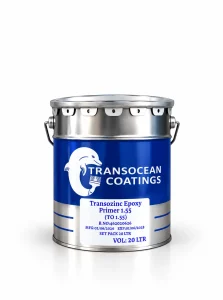
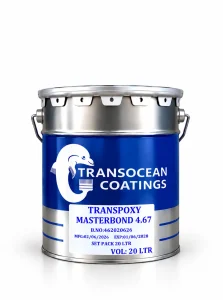
For example, our Transpoxy Masterbond BT (TO 4.68) product page lists use in approved IMO-PSPC systems for crude oil and ballast tanks. Always check the approval status of the exact system with the paint maker before you order.
See also our guides to the types of tank paints and to the marine coating specification.
Surface preparation for IMO PSPC ballast tanks
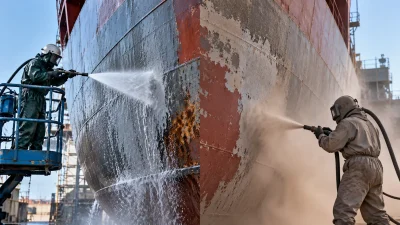
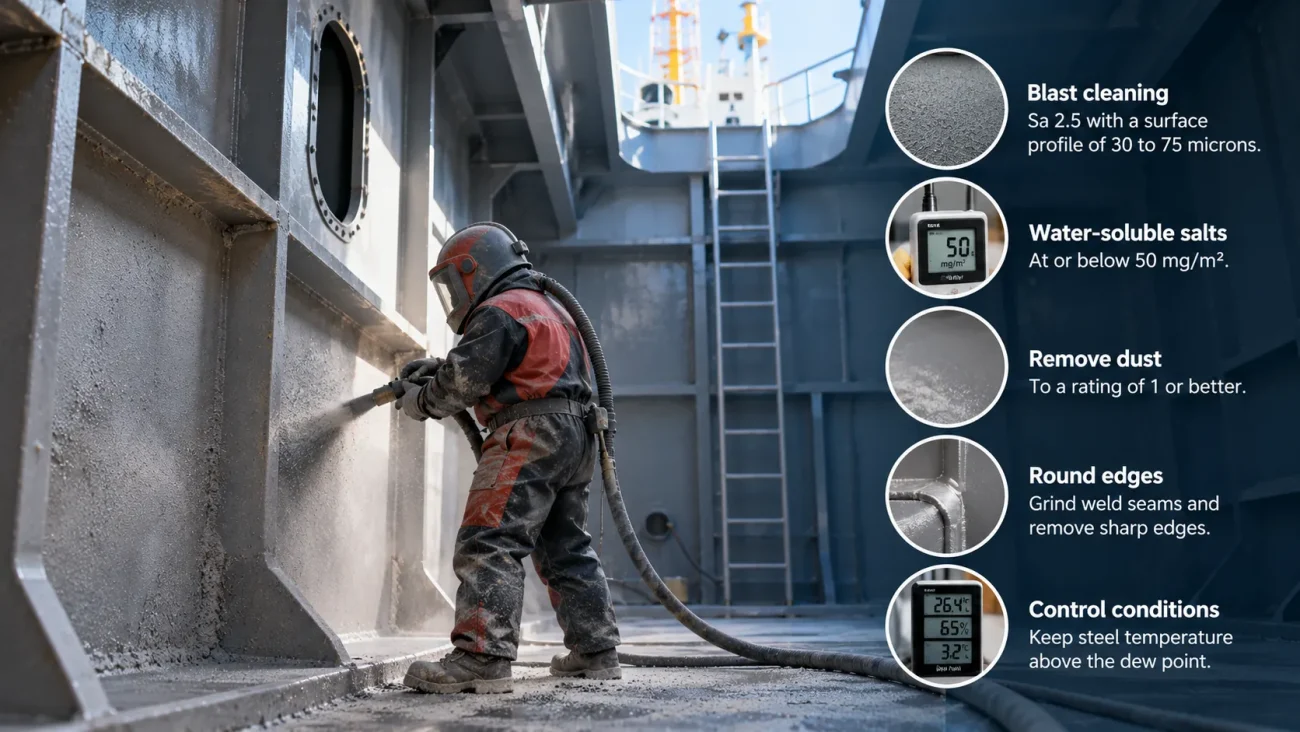
Most coating failures start before the paint is opened. PSPC sets clear limits for steel preparation:
- Blast clean to Sa 2.5 where required, with a surface profile of 30 to 75 microns.
- Keep water-soluble salts on the steel at or below 50 mg/m2.
- Remove dust to a rating of 1 or better.
- Round off sharp edges and grind weld seams, so paint can wrap the steel.
- Control humidity and keep steel temperature above the dew point, as the data sheet requires.
In the Gulf, humid air and hot steel make this hard. A tank that is blasted in the morning can show flash rust by the afternoon, so plan dehumidification and fast coating.
Application, film thickness and stripe coats in IMO PSPC ballast tanks
The standard calls for two spray coats with a nominal total dry film thickness of 320 microns. Thickness follows the 90/10 rule. At least 90 percent of readings must reach the target, and none of the rest may fall below 90 percent of it. The spec also limits excess thickness.
Stripe coats come first on edges, welds, cutouts and other places where paint thins out. They are applied by brush or roller. These details are where a tank coating usually breaks down.
The topcoat should be a light colour, so the inspector can see defects and rust easily. Overcoating times must follow the data sheet. Our posts on marine coating DFT and on the marine coating inspection checklist show how to measure and check each step.
The Coating Technical File
The Coating Technical File is the paper trail of the whole IMO PSPC ballast tanks job. It is not a single form. It is a set of documents kept together and passed on with the ship. It normally holds:
- The coating specification, with the approved system and the shop primer.
- The Type Approval Certificate and the paint maker’s statement of compliance.
- Shipyard application records, with dates, weather and batch numbers.
- Inspection reports, with film thickness readings.
- Records of repairs and later maintenance.
The file must stay on board. A good file saves time at every survey and dry dock. It also guides repairs later, because the crew can see exactly which system is in each tank.
Who does what: owner, yard, paint maker and inspector
IMO PSPC ballast tanks work gets its results from teamwork. The shipowner, the shipyard and the paint maker should agree the coating specification and the inspection plan at a pre-job meeting. Each party has a role:
- Shipowner: approves the specification, and keeps the Coating Technical File on board.
- Shipyard: prepares the steel, applies the coating and records every step.
- Paint maker: supplies the approved system and advises on application limits.
- Inspector: checks the work against the agreed plan. A NACE Level 2 or FROSIO Level III qualification, or equal, is required.
Disputes are cheaper to settle at the pre-job meeting than in the finished tank. Write down who holds each hold point, and who signs it.
Common IMO PSPC ballast tanks mistakes to avoid
Teams working on IMO PSPC ballast tanks projects often lose points on the same few issues. Watch for them:
- Weak records. The work is good, but readings and weather logs are missing.
- Skipped stripe coats. Edges and welds are the first places to rust.
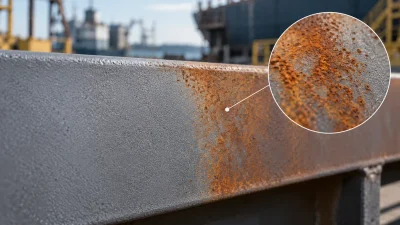
- Salt left on steel. Tests are skipped, and blisters appear later.
- Missed overcoating windows. Poor adhesion between coats follows.
- Unapproved products. A change at the last minute breaks the approved system.
Frequently asked questions
What are IMO PSPC ballast tanks rules?
IMO PSPC ballast tanks rules are the Performance Standard for Protective Coatings, adopted as resolution MSC.215(82). It sets rules for coating dedicated seawater ballast tanks on new ships. It covers coating system approval, surface preparation, application, inspection and records, with a target of 15 years in good condition.
Which ships need IMO PSPC ballast tanks coatings?
PSPC applies to dedicated seawater ballast tanks in new ships of 500 gross tons and above, and to double-side skin spaces of bulk carriers. It is tied to build dates in SOLAS regulation II-1/3-2. For older ships, ask your class society which rules apply to repairs.
What does the 15-year target in IMO PSPC ballast tanks rules mean?
It is the period the coating is expected to stay in good condition, meaning only minor spot rusting. It is a target, not a guarantee or a warranty. Real life depends on surface preparation, application quality, tank design, cathodic protection and maintenance after delivery.
What is a Coating Technical File?
The Coating Technical File is the record of the tank coating job. It holds the coating specification, the approval documents, the shipyard’s application records and the inspection reports. It stays on board for the life of the ship, so later IMO PSPC ballast tanks repairs follow the same standard.
Who inspects IMO PSPC ballast tanks coating work?
A qualified coating inspector checks surface preparation, environmental conditions, film thickness and cure. The standard asks for NACE Level 2, FROSIO Level III or an equivalent qualification. The inspector reports to the shipowner and the verifying body, and the records go into the Coating Technical File.
Do IMO PSPC ballast tanks rules cover cargo tanks?
No. PSPC under MSC.215(82) covers ballast tanks. Cargo oil tanks of crude oil tankers have their own standard, MSC.288(87). Chemical tanker cargo tanks follow the coating choices set by the cargo list and the paint maker. Always check the class rules for your ship type.
Get the right coating for your ballast tanks
Planning a ballast tank job and need a coating that fits IMO PSPC ballast tanks requirements? Request a quote for Transpoxy Masterbond BT (TO 4.68). Send us the tank type, the steel preparation and the approval you need, and our team will help match the system and data sheet to your project. You can also browse our ballast tank coatings (IMO PSPC) category.