


Every paint order comes with a document that few people read to the end. A marine coating technical data sheet holds the numbers that decide cost, schedule and film quality. Reading it fast and correctly saves time and avoids costly mistakes.
This guide is for purchasing managers, superintendents and contractors in the UAE and Oman. It shows what to look at first on every marine coating technical data sheet, and what each figure means in practice.

Contents
- What a marine coating technical data sheet contains
- 1. A fast reading order for a TDS
- 2. Volume solids and theoretical coverage
- 3. Film thickness: wet and dry
- 4. Drying times and the overcoating interval
- 5. Application conditions
- 6. Surface preparation and system fit
- 7. TDS vs SDS
- Common mistakes when reading a TDS
- Frequently asked questions
What a marine coating technical data sheet contains
A technical data sheet, often called a TDS or TDS paint document, describes one product. It is written by the manufacturer. It tells you what the paint is, how to apply it and how it should perform.
A typical marine coating technical data sheet has these blocks:
- Product description: type of resin, intended use and area of the ship.
- Technical data: colour, gloss, volume solids and theoretical coverage.
- Application data: film thickness, mixing ratio, thinner and tools.
- Drying data: touch dry, hard dry and overcoating times.
- Surface preparation: required steel standard and profile.
- Storage and limits: shelf life, pot life and a disclaimer.
The layout changes between brands. The information is the same. You can find product documents on our documents and downloads page.
1. A fast reading order for a TDS
You do not need to read every line first. Use this order when you open a new marine coating technical data sheet:
- Check the product name, type and revision date.
- Read the recommended use and the coating system it belongs to.
- Note the volume solids and the dry film thickness range.
- Find the overcoating interval at your site temperature.
- Check the application limits: steel temperature, dew point and humidity.
- Confirm the surface preparation level.
These six checks take a few minutes. They answer most questions from a buyer or an inspector.
2. Volume solids and theoretical coverage
Volume solids is the first number to read on any marine coating technical data sheet. It shows how much of the wet paint becomes dry film. The rest is solvent that leaves during drying.
Two paints with the same price per litre can give very different film. The paint with higher volume solids gives more dry film from each litre. That is why a cheap litre is not always a cheap square metre.
The data sheet usually lists the theoretical coverage for a given film thickness. You can also calculate it:
- Theoretical coverage (m² per litre) = volume solids (%) × 10 ÷ dry film thickness (µm).
- Example: 60% volume solids at 200 µm gives 3 m² per litre.
Theoretical coverage assumes no loss. Real jobs lose paint on spray, rough steel, wind and leftover in the pot. Add a loss factor when you order. For a full method, read our guide to marine paint consumption.
3. Film thickness: wet and dry
Film thickness is shown as a range, for example a minimum and a nominal value. The TDS gives it as dry film thickness (DFT) in microns. One micron is a micrometre, one thousandth of a millimetre.
Many data sheets also give a wet film thickness (WFT). The painter checks WFT during application to be sure the dry film will be right. The link between them is simple:
- WFT = DFT ÷ volume solids (as a fraction).
- Example: 200 µm DFT at 60% volume solids needs about 333 µm WFT.
Too thin and the coat gives less protection. Too thick and it can crack or trap solvent. Read the maximum as carefully as the minimum. Our guide to marine coating DFT explains how to measure and record it.

4. Drying times and the overcoating interval
Drying data is shown as a table. It lists times against steel temperature. Typical columns are touch dry, hard dry, minimum overcoating interval and maximum overcoating interval.
The overcoating interval controls the schedule of every job. It has two limits:
- Minimum: the earliest time you may apply the next coat. Going earlier can trap solvent.
- Maximum: the latest time without extra work. After this, the surface may need abrasion or a special step before recoating.
Some products, such as epoxies, have a maximum overcoating interval. Others stay recoatable for a long time. The interval also changes with temperature. Warm steel cures faster, so the window moves earlier. Cool steel slows it.
Always take the value from the column that matches the steel temperature on site. Plan each marine coating technical data sheet interval into the work schedule before the job starts. Compare product families in our marine epoxy coatings range.
5. Application conditions
The application section of the marine coating technical data sheet sets the limits for a good result. Check these items:
- Steel temperature: usually at least 3 °C above the dew point.
- Relative humidity: a maximum value for the product.
- Mixing ratio: for two-pack paints, the ratio of base to hardener.
- Pot life: the time you can use the mixed paint.
- Thinner and tools: the approved thinner, nozzle and spray pressure.
In the Gulf, heat and humidity can push a job outside these limits. Check readings at every shift and record them. These records protect the owner and the contractor if a coat fails later.
6. Surface preparation and system fit
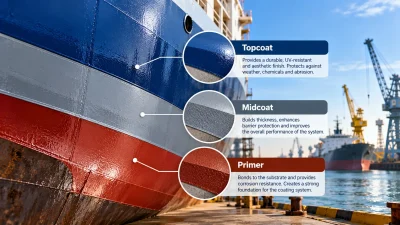
A TDS covers one product, but a ship uses a system of coats. Read the surface preparation line first. It shows the required steel standard, such as blast cleaning, and the surface profile.
Then check the system fit:
- Which primer does the data sheet allow underneath?
- Which topcoats are listed as suitable above it?
- Is the product suitable for the exposure, such as immersion, atmospheric or tank use?
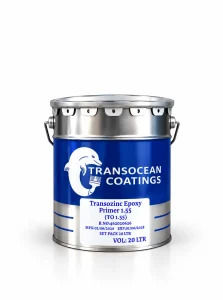
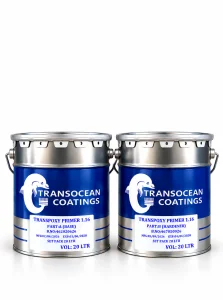
For example, the data sheet of Transpoxy Primer A&B gives the preparation, film thickness and overcoating details for that primer. Use the same approach for every layer. To see how the layers work together, read our guide to the marine coating system, and write the full scope in a marine coating specification.
7. TDS vs SDS
Buyers sometimes mix up the two key documents. Both are needed, but they answer different questions.
- TDS: how to apply the product and what performance to expect.
- SDS: hazards, handling, storage and emergency steps. See the general background on a safety data sheet.
Before you approve a product, keep both documents in the file. Check the revision date on each one, and make sure it matches the batch delivered.
Common mistakes when reading a TDS
- Reading only the price and colour. The volume solids and DFT decide real cost.
- Using air temperature. The TDS table is based on steel temperature.
- Ignoring the maximum overcoating interval. Poor adhesion between coats follows.
- Mixing data sheet revisions. An old copy may show old values.
- Forgetting the loss factor. Theoretical coverage is never the real coverage.
A short check of the marine coating technical data sheet before ordering avoids most of these problems.
Frequently asked questions
What is a marine coating technical data sheet?
A marine coating technical data sheet (TDS) is the manufacturer’s document for one paint product. It lists the product type, volume solids, film thickness, drying and overcoating times, application limits and thinner. Use it to plan and check the coating job.
What does volume solids mean on a TDS?
Volume solids is the share of the wet paint, by volume, that stays on the surface as dry film. A higher figure means less solvent loss and more dry film per litre. It is the key number for calculating theoretical coverage and paint quantity.
How do I calculate theoretical coverage from a TDS?
Divide the volume solids percentage by the dry film thickness in microns and multiply by 10. The result is the theoretical coverage in square metres per litre. Practical coverage is lower because of loss on spray, rough steel and wind.
What is the overcoating interval?
The overcoating interval is the time window between one coat and the next. Too early and solvent can be trapped. Too late and the old coat can be too hard for good adhesion. The TDS gives minimum and maximum times for each temperature.
Why does the TDS give drying times at different temperatures?
Paint cures faster in warm conditions and slower in cool ones. The data sheet therefore lists touch dry, hard dry and overcoating times at several temperatures. Always read the value that matches the steel temperature on site, not the air temperature.
What is the difference between a TDS and an SDS?
The TDS explains how to apply the paint and what performance to expect. The safety data sheet (SDS) explains hazards, handling, storage and first aid. A buyer or superintendent needs both documents before a product is approved for use.
Where can I download marine paint data sheets?
Request them from your supplier or from the manufacturer’s document library. Bahari Tech keeps product documents for TransOcean marine paints on its documents and downloads page. Always check that the data sheet revision matches the batch you receive.
Need help reading a marine coating technical data sheet?
Need data sheets or help to check a coating system? Browse our documents and downloads for product data sheets, or contact us with your product list and project dates. Our team will help you check the figures and prepare a quote.