

A tug does not lead an easy life. It pushes against ships, rubs on quays, drags ropes over its rails and then sits idle in warm water. A well-planned tugboat paint system is what keeps the steel sound through all of this.
This guide is for ship owners, tug and workboat operators and marine service managers in the UAE and Oman. You will learn how to split a tug into coating zones, which epoxy, polyurethane and antifouling layers suit each zone, and when to repaint.
Why tugs and workboats need their own tugboat paint system
Most cargo ships are painted for a long, steady voyage. A tug is different. Its duty is short, hard and repeated. A good tugboat paint system is built around that duty, not around a generic ship specification.
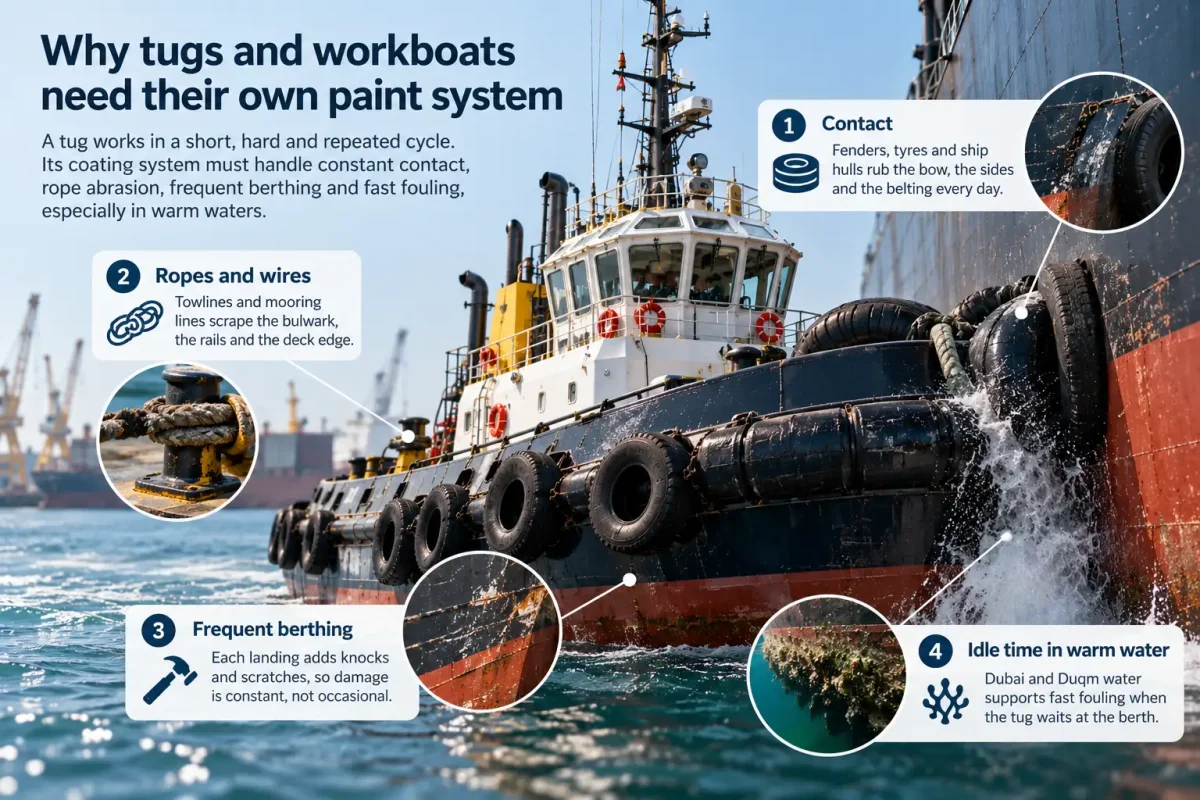
Four things set tugs and harbour craft apart:
- Contact. Fenders, tyres and ship hulls rub the bow, the sides and the belting every day.
- Ropes and wires. Towlines and mooring lines scrape the bulwark, the rails and the deck edge.
- Frequent berthing. Each landing adds knocks and scratches, so damage is constant, not occasional.
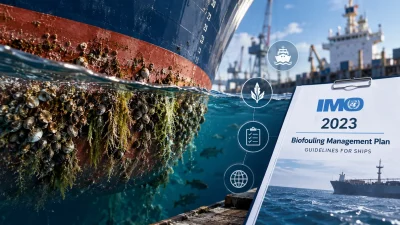
- Idle time in warm water. Dubai and Duqm water supports fast fouling when the tug waits at the berth.
Heat and strong sun add to this. For the wider picture of how coats work together, read our guide to the marine coating system.
The five coating zones of a tug
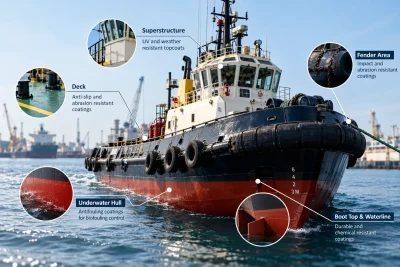
The simplest way to plan a tugboat paint system is to treat each zone as its own job. One product rarely suits all of them. Here are the five zones.
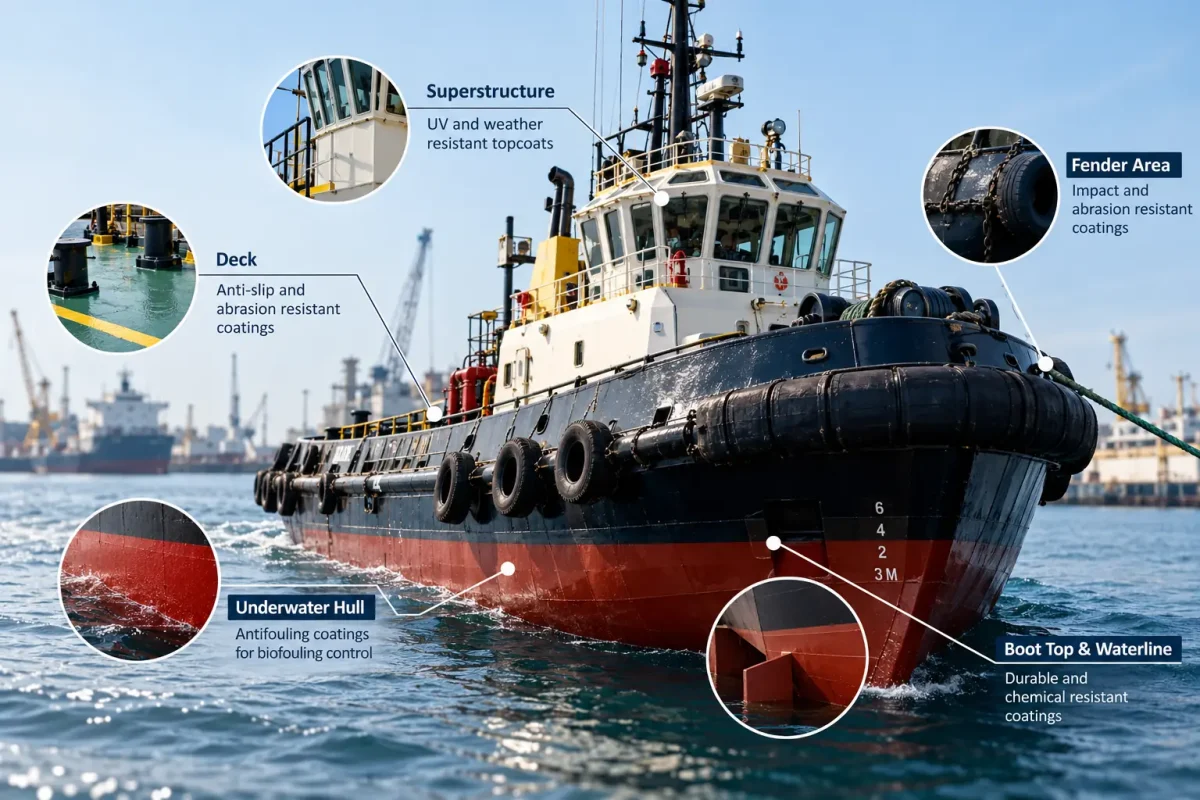
- Underwater hull. Always wet. Needs corrosion protection plus antifouling.
- Boot-top and waterline. Wet, dry and wet again with every change of draft. Needs toughness and good adhesion.
- Topsides and superstructure. Above water, in sun and spray. Needs colour and gloss retention.
- Deck and working areas. Walked on, hit by gear and splashed with fuel and oil. Needs wear resistance and grip.
- Fendering and belting zone. Takes the heaviest mechanical abuse. Needs maximum abrasion resistance.
Write each zone of the tugboat paint system into the specification with its own product, coat count and dry film thickness.
Underwater hull: epoxy barrier and tug hull antifouling
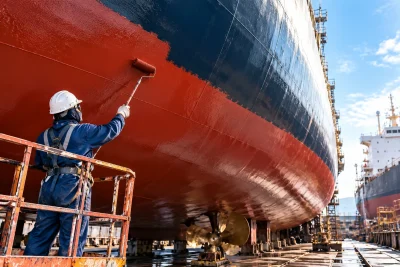
Below the waterline, the steel needs two lines of defence. First, a barrier that stops seawater reaching the metal. Second, a surface that resists marine growth.
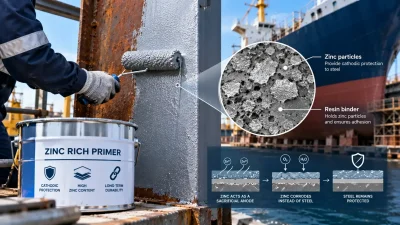
The barrier is usually an anticorrosive epoxy primer followed by one or more epoxy build coats. Epoxy is hard, adheres well to blasted steel and resists water. It is the base of most underwater tug hull paint schemes. If you want to see why epoxy and polyurethane play different roles, our article on marine epoxy vs polyurethane explains it step by step.
On top of the barrier goes the antifouling. It stops barnacles, weed and slime from settling. Harbour craft antifouling must match the real duty:
- A tug that works every day and moves a lot has different needs from one that waits at anchor for weeks.
- Warm water raises the fouling pressure, so a thin or low-grade film wears out sooner.
- Two antifouling types, self-polishing and hard matrix, behave differently in service.
Our guide to antifouling paint types compares them, so you can build the right tugboat paint system and pick one that suits a tug that stops and starts. Share the speed, the idle days and the area of operation with your supplier before you choose.
A tug’s hull also gets scraped by fenders and ropes, so watch the turn of the bilge and the bow. Add extra film on these edges, because paint thins out on sharp corners.
Topsides: epoxy build with a polyurethane finish
Topsides sit in sun, salt spray and heat. Here the tugboat paint system needs more than corrosion protection. It also needs a finish that keeps its colour and gloss.
A common build for topsides is:
- an epoxy primer on blasted or prepared steel,
- an epoxy intermediate coat to build film thickness,
- a polyurethane topcoat for UV stability and gloss.
Why not use epoxy all the way in the tugboat paint system? Ordinary epoxy tends to chalk and fade in strong sunlight. A polyurethane finish holds colour much better and is easier to clean. This is the reason most marine specifications put polyurethane on top of epoxy above the waterline.
The same logic applies to the wheelhouse, funnel, rails and bulwarks.
For a Duqm yard, the ship repair coatings in Duqm page shows how coating work is planned in Oman’s ship repair setting.
Deck coating for tugs and workboats
The deck is the busiest part of any tugboat paint system. It is a working surface. Crew walk on it with wet boots. Wires, shackles and tools land on it. Fuel, hydraulic oil and seawater run across it.
A tug deck coating needs three things: strong adhesion, abrasion resistance and slip resistance. Many owners choose an epoxy deck system with a non-slip aggregate in the film. It gives grip without needing a separate mat.
Remember these practical points:
- Prepare the steel properly. A deck coat is only as good as the surface under it.
- Apply the coat in the right conditions, not on hot, damp or dusty steel.
- Check the film thickness at the edges, around hatches and at welds.
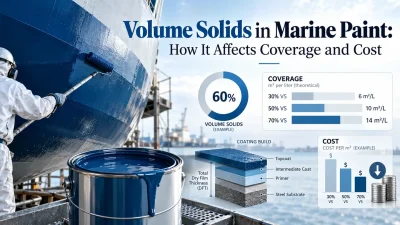
Film thickness is the number that decides how long a deck coat lasts. Our guide to marine coating DFT explains how it is specified and checked. You can also test adhesion on site with a pull-off method such as ASTM D4541.
Fendering and belting zone: the toughest area
The belting and fender zone is where a tug system is tested most. Rubber, tyres, ropes and steel hulls rub it again and again. Once the paint breaks, seawater reaches bare steel and rust spreads under the film.
For this reason, treat the zone as a separate part of the tugboat paint system:
- Use a high-build, abrasion-resistant epoxy rather than a thin finish.
- Add extra coats in the contact band, from the bow round the stem to the fender line.
- Round off sharp edges during preparation, so the paint does not thin out there.
- Plan quick touch-ups, because damage here is certain and not a surprise.
Use a different colour for the abrasion coat if your class or owner allows it. Then worn spots show up early at inspection, and you can fix the damage before the steel is exposed.
You can read more about the design and duty of tugboats to see why this belt takes such punishment.
Application tips for Dubai and Duqm conditions
The climate in Dubai and Duqm affects every coat in the tugboat paint system. Hot steel, high humidity and warm water make the job harder.
- Surface temperature. Steel in the sun can be much hotter than the air. Paint may dry too fast, or solvents may be trapped in the film.
- Humidity. Damp air can leave moisture on steel at night. Never coat a wet surface.
- Salt contamination. Salt on the steel causes early blisters. Wash with fresh water before painting.
- Fouling. Warm water grows marine life quickly, so idle tugs need a reliable antifouling.
Check the steel temperature and the dew point before each coat, and stay inside the limits on the data sheet.
When to repaint a tugboat: a 5-step plan
The best repaint plan for a tugboat paint system combines the calendar and the actual condition of the paint. Do not wait until rust is everywhere. Waiting makes the job larger and the bill higher.
Use this practical plan:
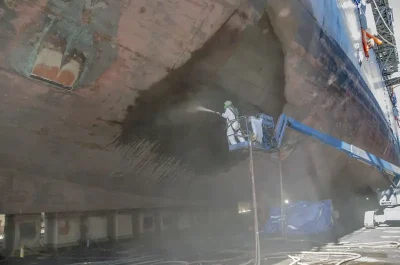
- Follow the survey cycle. Use the dry-docking or underwater survey slot to renew the underwater system and the antifouling.
- Inspect every few months. Walk the deck and topsides and look at the belting. Take photos and record the findings.
- Touch up early. Repair scratches and chipped edges while the steel is still clean.
- Recoat when the film fails. Rust bleed, blisters, peeling, heavy chalking and thin film are all warning signs.
- Check DFT after each job. Record the thickness in each zone for the next planning round.
Ask your supplier for the stated service life of each product on the data sheet and plan from that, with the survey dates in mind.
Frequently asked questions
What is a tugboat paint system?
A tugboat paint system is the full set of coats applied to a tug, from surface preparation and primer to the intermediate and finish coats. The system changes by zone: underwater hull, boot-top, topsides, deck and fendering area. Each zone gets the products and film thickness that suit its exposure.
Which paint is best for a tug hull below the waterline?
A tug hull below the waterline normally takes an anticorrosive epoxy primer and build coats, then an antifouling topcoat that suits the tug’s speed and idle time. The exact products come from the system maker and the class or owner specification. Confirm the choice against the data sheet.
How often should a tugboat be repainted?
There is no single interval. Repainting follows the dry-docking or underwater survey cycle, the condition found at inspection, and the antifouling service life stated on the data sheet. Spot repair damaged areas early, and plan a full topside or deck recoat when film breakdown or rust starts to spread.
Why do tug fender zones need a tougher coating?
Tug fender zones take repeated contact with ships, quays and ropes. Rubber and rope abrade the paint, and any broken film lets seawater reach bare steel. A high-build abrasion-resistant epoxy gives a thicker film in this belt, and a damage-tolerant finish makes touch-up quicker.
Can one epoxy cover the whole tugboat?
No. Epoxy suits primers, hull build coats and decks, but ordinary epoxy chalks in strong sunlight. Topsides in the UAE and Oman need a UV-stable polyurethane finish over the epoxy. Underwater areas need antifouling. Use the right product for each zone and keep the coats compatible.
Does a tug that sits idle in warm water need a different antifouling?
Yes, idle time matters. Fouling grows fast in warm Gulf water, and a tug that waits at the berth for long periods gives it more time to settle. Tell the supplier the real speed, idle days and trading area, so the antifouling type and thickness match the actual duty.
Get a coating plan for your tug
Planning a new tugboat paint system or a repaint for a tug or workboat in the UAE or Oman? Request a quote for TransOcean marine paints and tell us the zones, the area and the target DFT. Our team will send the data sheets so you can match each layer to the hull, topsides, deck and fendering zone.