

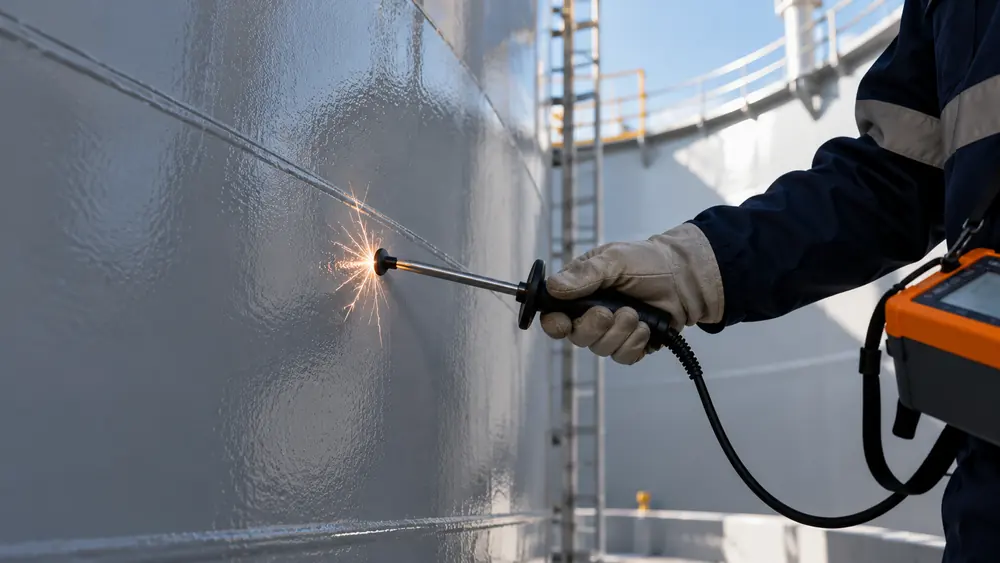
A tiny pinhole in a tank lining can start a rust spot that spreads under the film. You will not see most of these defects by eye.
This guide explains holiday testing coatings in plain words. It covers the spark test, the low-voltage wet sponge test, the thickness limit between them and how to avoid false alarms in marine tanks.
Why holiday testing coatings matters in marine tanks
A holiday is a gap in a coating. It may be a pinhole, a skipped area, a thin spot or a crack. In a ballast or cargo tank, a single holiday lets water and salt reach bare steel.
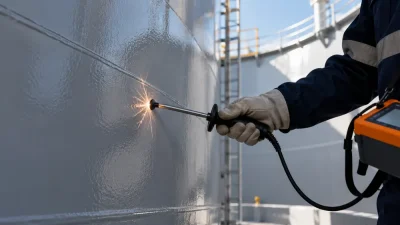
Holiday testing coatings is the standard way to find these gaps. A detector sends an electrical signal through the film. Where the film is missing or too thin, the signal reaches the steel and the detector gives an alarm.
It is a quality check, not a repair. It tells you where to fix the film before the tank goes into service. It sits next to the checks for thickness and cure that we describe in our guide to marine coating DFT.
The test works because the coating is an electrical insulator and the steel is a conductor. You can read more about this property in this overview of dielectric strength.

Most holidays form in the same places. Sharp edges, weld toes, bolts, corners and rough weld spatter all pull the paint thin. Good preparation lowers the count, and the test finds what is left.
Low-voltage wet sponge vs high-voltage spark test
Two main methods are used on tank linings. Both detect current through a defect, so both count as holiday testing coatings. They differ in voltage and in how they touch the surface.
- Low-voltage wet sponge test. A damp sponge is moved over the coating. It uses a low voltage and a ground lead on the steel. It finds pinholes in thin films. It does not create sparks.
- High-voltage spark test. A brush or probe moves over the coating at high voltage. A spark jumps through a thin spot or hole. The spark test is used for thicker films.
The wet sponge test is gentle on the film. A water-based wetting agent is sometimes added to help the sponge conduct. The spark test needs a dry surface and care, because the voltage can harm a thin film.
Both methods are covered by the standard NACE SP0188, now issued under AMPP, and by ASTM D5162. Ask your inspector which one the project cites.
The 500 micron (20 mil) threshold
The choice of method for holiday testing coatings mostly comes down to film thickness. A common rule is simple:
- Under about 500 microns (20 mils): use the low-voltage wet sponge test.
- Over about 500 microns (20 mils): use the high-voltage spark test.
The reason is practical. A thick film hides a pinhole from a low voltage, so the signal never reaches the steel. A thin film cannot take the high voltage that a thick film needs.
Treat 500 microns as a guide, not a law. Some products have their own limit. Check the marine coating technical data sheet and the project specification before you choose the method.
Measure thickness first. The numbers from your DFT gauge tell you which side of the line you are on.
Technique: single pass, voltage and speed
Good technique matters as much as the equipment in holiday testing coatings. Follow these rules for a reliable spark test.
- Set the voltage on a known defect. Make a small test holiday on a sample panel. Raise the voltage until the detector alarms. Then use the voltage the standard and the paint maker allow.
- Keep the probe moving. A steady speed of about 0.3 metres per second (1 foot per second) is typical. Check the standard for the exact limit.
- Make a single pass. Do not go back and forth over the same area. Repeated high voltage can puncture a good film and create a new holiday.
- Keep the ground lead connected. Attach it firmly to bare steel, not to the coating.
- Mark each hit. Use chalk or a marker so the repair crew can find every defect.
The same steady, single-pass rule applies to a wet sponge. Move the sponge slowly and overlap each stroke a little. A fast sponge can skip a pinhole.
Surface bloom and false alarms
Holiday testing coatings can give an alarm when nothing is wrong. False alarms waste time and can mislead the crew. Know the common causes.
- Surface bloom. Some epoxies leave a waxy or sticky layer as they cure. It holds moisture and salts. These can carry current and trigger the alarm.
- Wet or dirty film. Water, salt or dust on the surface can bridge to the steel. Clean and dry the film before a spark test.
- Conductive coatings. A zinc-rich primer is conductive. Test the finished non-conductive system, not the primer.
- Bad ground. A weak ground lead gives weak or false signals.
- Edges and corners. A real thin spot may be a true holiday. Confirm by looking and by measuring thickness.
When the detector alarms, do not assume a hole. Look closely, wipe the area and test again once. If it still alarms, mark it and measure the thickness. Treat it as a real defect until proven otherwise.
Safety and compatibility checks
Safety comes first in a tank. A spark can ignite flammable vapour, so the tank must be gas-free and approved for the work. Follow the confined space rules at your yard.
Check compatibility before you start. The detector, the voltage and the wetting agent must suit the coating. Ask the paint maker to confirm, and use the product’s data sheet as the reference. Standards such as NACE SP0188 are a guide, not a replacement for the maker’s advice.
Plan the holiday testing coatings step in the specification. It should say which coats to test, the method, the voltage and who signs off. Our guide to the marine coating specification shows how to write this clearly. For the wider picture of tank linings, read about ballast tank coatings.
Six steps for holiday testing coatings in a tank
Use this checklist on your next tank:
- Confirm the cure. Check the data sheet for the minimum cure time before testing.
- Clean and inspect. Remove dust, salt and any surface bloom. Look for obvious defects.
- Measure thickness. Decide the method from the film thickness and the specification.
- Set up the detector. Connect the ground and set the voltage on a known defect.
- Test with one steady pass. Mark every alarm as you go.
- Repair and retest. Prepare the spot, recoat as the data sheet allows and test the repair again.
Record the results of holiday testing coatings in the inspection report. A clean record helps the owner, the class surveyor and the next maintenance team.
Frequently asked questions
What is holiday testing of coatings?
Holiday testing is an electrical inspection that finds pinholes, thin spots and cracks in a protective coating on steel. A detector applies voltage to the film. Where the film is missing or too thin, current reaches the steel, and the detector sounds an alarm so the defect can be marked and repaired.
What is the difference between a low-voltage and a high-voltage holiday test?
A low-voltage test uses a damp sponge and a low voltage, and suits thin films. A high-voltage spark test uses a probe and a much higher voltage, and suits thick films. The usual dividing line is about 500 microns (20 mils). Always confirm the limit in your project specification.
What voltage should I use for a spark test?
The voltage depends on the film thickness and the coating type. Standards such as NACE SP0188 and ASTM D5162 give guidance, and the paint maker may state its own value. Set the detector on a known holiday first, and never exceed the maker’s limit, because too much voltage can damage the film.
When should holiday testing be done on a tank coating?
Test after the coating has cured, as the data sheet describes, and before the tank goes into service. Check the dry film thickness first. Test each coat only if the specification asks for it. Repair every defect, then retest the repaired spots.
Can holiday testing damage the coating?
Yes, if it is done badly. High voltage on a film that is too thin, or repeated passes over the same spot, can puncture the coating and create new holidays. Use the correct voltage, keep the probe moving and make only a single pass over each area.
Can you holiday test a zinc-rich primer?
No. Holiday detectors need a non-conductive coating on a conductive steel substrate. A zinc-rich primer conducts electricity, so the test would read as one big holiday. Test the finished non-conductive system instead, and check the coating’s data sheet for approved methods.
Need help with tank lining inspection?
Planning a tank lining or a repair in the UAE or Oman? Contact our team for help choosing a TransOcean system and a clear inspection plan. You can also download product data sheets to check cure times and thickness limits.