

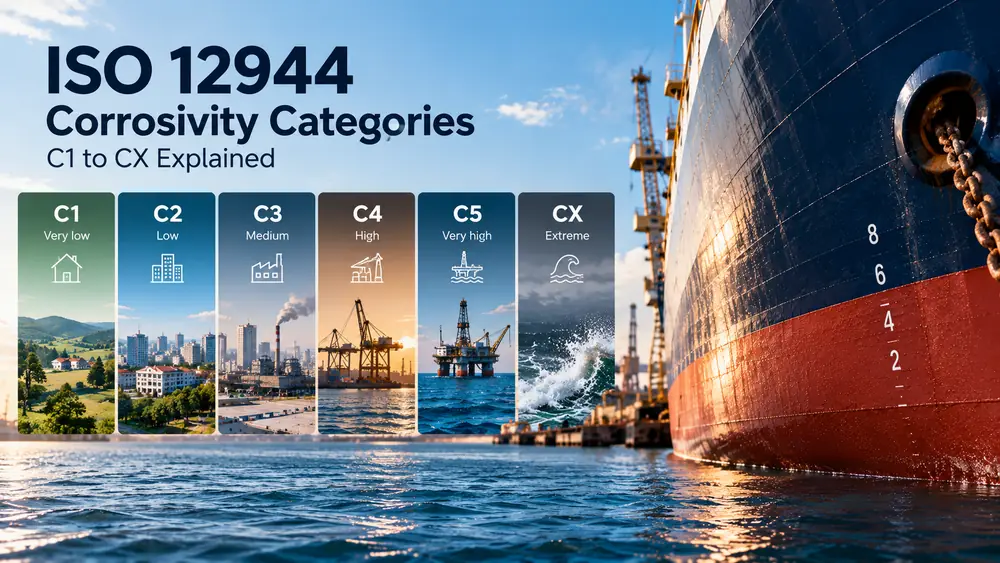
Choosing a coating without knowing the exposure is guesswork. The ISO 12944 corrosivity categories give you a shared language for how aggressive the air around a steel structure is.
This guide explains the ISO 12944 corrosivity categories from C1 to CX in plain words. It covers durability, the 2018 changes and how a coastal or offshore project in the UAE or Oman can turn a category into a coating system and film thickness.
What the ISO 12944 corrosivity categories are
ISO 12944 is the international standard for protecting steel structures with paint. It has several parts. Part 2 sorts the environment into classes, and the ISO 12944 corrosivity categories are the core of that part.
The ISO 12944 corrosivity categories are based on real corrosion. Standard low-carbon steel and zinc samples are exposed for one year. Their loss of mass and thickness is then measured. A higher loss means a higher category. You can read the background on the chemistry in this overview of corrosion.
The result is a simple scale from C1 to CX. Designers, buyers and applicators all use it. It links the site to the paint system, so everyone prices and applies the same thing.
Atmospheric categories cover steel in air. The standard also has classes for steel in water or soil (Im1 to Im4). This article focuses on the air categories because most projects start there.
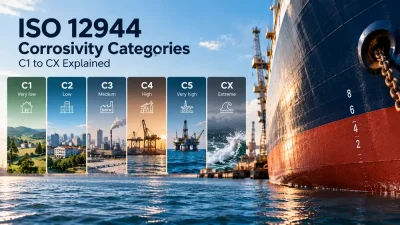
The ISO 12944 corrosivity categories from C1 to CX
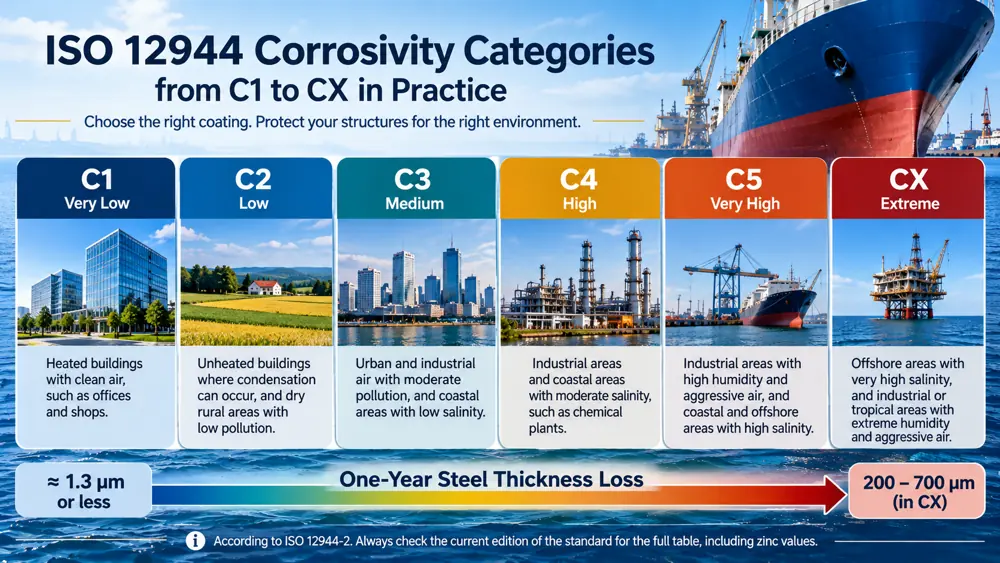
Here is how the ISO 12944 corrosivity categories look in practice. The examples come from the typical environments given in the standard. Always judge your own site, not just the label.
- C1, very low: heated buildings with clean air, such as offices and shops.
- C2, low: unheated buildings where condensation can occur, and dry rural areas with low pollution.
- C3, medium: urban and industrial air with moderate pollution, and coastal areas with low salinity.
- C4, high: industrial areas and coastal areas with moderate salinity, such as chemical plants.
- C5, very high: industrial areas with high humidity and aggressive air, and coastal and offshore areas with high salinity.
- CX, extreme: offshore areas with very high salinity, and industrial or tropical areas with extreme humidity and aggressive air.
The one-year steel thickness loss is what separates the classes. It runs from about 1.3 micrometres or less in C1 to between 200 and 700 micrometres in CX, according to ISO 12944-2. Check the current edition of the standard for the full table, including zinc values.
What changed in 2018: CX and the end of C5-M
ISO 12944 was revised in 2018. Two changes matter most for coastal and marine work.
- CX was added. The CX corrosivity category is the new extreme class. It is meant for the harshest air, mainly offshore and tropical industrial sites.
- C5-M was removed. The older edition split very high corrosivity into C5-I (industrial) and C5-M (marine). The 2018 revision merged them into a single C5.
Offshore exposure moved to the CX corrosivity category. Paint systems for it are covered by ISO 12944-9, which sets laboratory performance tests for offshore and related structures. Some older tender documents still say C5-M. Treat that as obsolete and ask for a clear category before you quote.
Part 9 is also why the ISO 12944 corrosivity categories matter more to offshore buyers now. A system is no longer just listed. It has to pass defined tests.
Durability ranges: low to very high
The category tells you how harsh the site is, and the ISO 12944 corrosivity categories are only half of the picture. Durability tells you how long the paint should last before major maintenance. The standard uses four ranges:
- Low: up to 7 years.
- Medium: 7 to 15 years.
- High: 15 to 25 years.
- Very high: more than 25 years.
Durability is not a guarantee. It is a planning figure for the time to first major maintenance under the stated environment. A good ISO 12944 durability target is chosen with the owner. A remote offshore asset often needs a longer range than a building that is easy to repaint.
Many project specifications combine both values, for example “C5 high” or “CX very high”. That short code sets the whole job.
Which category fits the UAE and Oman?
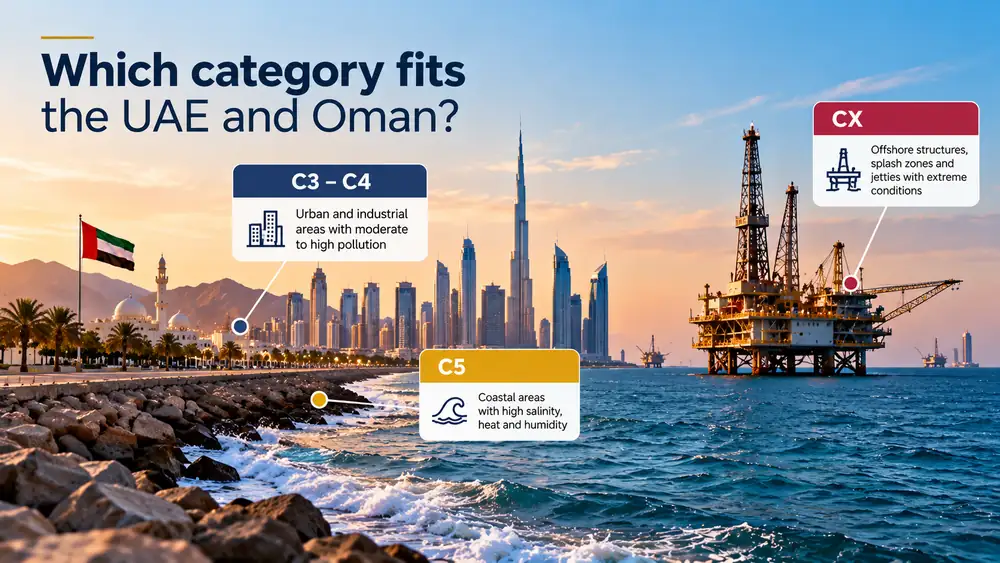
Salt, heat and humidity all push corrosion up on the Gulf coast. Steel close to the shore in the UAE or Oman is often assessed as C5. Splash zones, jetties and offshore structures can reach the CX corrosivity category.
That said, the category is a site decision. It depends on distance from the sea, wind direction, salt deposition and local pollution. Two sites a few kilometres apart can differ. Ask the designer or a corrosion engineer to confirm the category, and write it into the specification.
For a view of how this works on real structures, read our guide to anti-corrosion coatings for offshore platforms.
From category to coating system and DFT
Once the category and durability are known, the paint system follows. The ISO 12944 corrosivity categories drive three choices: surface preparation, the layers, and the total dry film thickness (DFT).
Surface preparation. Higher ISO 12944 corrosivity categories need cleaner steel. Abrasive blasting to a high standard is normal for C5 and CX. A weak profile or leftover salt causes early failure, whatever the paint.
Layers. The usual pattern is a primer, one or more build coats and a topcoat. In severe exposure, a zinc-rich or epoxy primer is common. An epoxy build coat adds barrier protection, and a polyurethane topcoat resists UV light. Our guide to marine primers and anti-corrosive coatings explains each layer.
Film thickness. More corrosive means a thicker system. The figures below are indicative planning ranges for multi-coat epoxy and polyurethane systems. Confirm them against the tables in ISO 12944-5 and -9 and the product data sheet.
- C2 and C3: roughly 80 to 200 micrometres.
- C4: roughly 200 to 280 micrometres.
- C5: roughly 280 to 360 micrometres.
- CX: roughly 320 micrometres or more, as set by the ISO 12944-9 system.
Thickness must be measured, not assumed. See how to measure marine coating DFT for the method and the common mistakes.
Five steps to specify by corrosivity category
Use this short path on your next coastal or offshore job:
- Confirm the category. Get the ISO 12944 corrosivity categories assessed for the exact site, in writing.
- Set the durability. Agree low, medium, high or very high with the asset owner.
- Pick a tested system. Choose a system from ISO 12944-5 or, for the CX corrosivity category, one tested to ISO 12944-9.
- Write the DFT and prep. State the blast standard, the layers and the thickness for each coat.
- Inspect and record. Check the profile, the climate and the DFT at each stage.
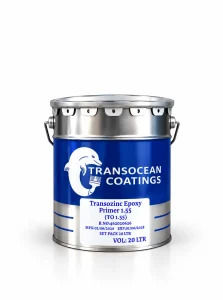
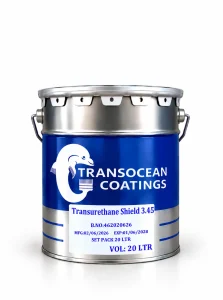
Our article on the marine coating specification shows how to put these steps into a clear document. You can also browse the TransOcean paint range for primers, epoxies and polyurethane finishes. Compare the data sheets with your chosen system.
A well-written specification that names the ISO 12944 corrosivity categories saves time at the yard. It also makes later maintenance easier, because the next team can see what was applied and why.
Frequently asked questions
What are the ISO 12944 corrosivity categories?
ISO 12944 defines six atmospheric corrosivity categories: C1 very low, C2 low, C3 medium, C4 high, C5 very high and CX extreme. Each one is based on how much a standard steel sample corrodes in its first year. The category tells you how demanding the paint system must be.
What does CX mean in ISO 12944?
CX is the extreme corrosivity category added in the 2018 revision. It covers offshore areas with high salinity and industrial or tropical atmospheres with extreme humidity and aggressive pollution. Paint systems for CX are tested under the offshore rules in ISO 12944-9.
Is C5-M still used in ISO 12944?
No. The old C5-I and C5-M split was removed in the 2018 revision. Marine and industrial exposure now sit under a single C5 category, and offshore exposure moved to CX. If a specification still says C5-M, ask the author to update it to C5 or CX.
What are the ISO 12944 durability ranges?
ISO 12944 uses four durability ranges: low is up to 7 years, medium is 7 to 15 years, high is 15 to 25 years, and very high is more than 25 years. Durability is the time to the first major maintenance, not a warranty period.
Which category applies to coastal sites in the UAE and Oman?
Most exposed coastal steel in the Gulf is assessed as C5, and splash zones or offshore structures may reach CX. The right answer depends on distance from the sea, wind, salt deposition and pollution at your exact site. Ask the designer to confirm the category in writing.
How does the category change the coating system and DFT?
A higher category needs a tougher system and more film thickness. A C3 steel structure may use a two-coat system, while C5 and CX usually need a zinc-rich or epoxy primer, an epoxy build coat and a polyurethane topcoat at a higher total DFT. Follow the system tables in ISO 12944-5 and -9.
Is ISO 12944 the same as ISO 12944-9?
No. ISO 12944 is a multi-part standard. Part 2 classifies environments and part 5 covers paint systems. Part 9 is a separate part that covers protective paint systems and laboratory performance tests for offshore and related structures, and it is the one used for CX exposure.
Need help choosing a coating system?
Not sure which of the ISO 12944 corrosivity categories fits your project? Contact our team with the site location, structure type and target durability. We will help you match a TransOcean system to the category and prepare a quote. You can also download product data sheets.