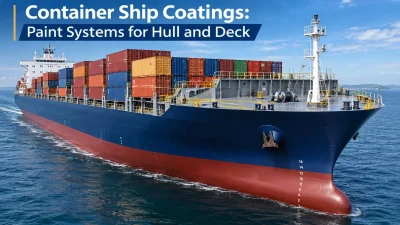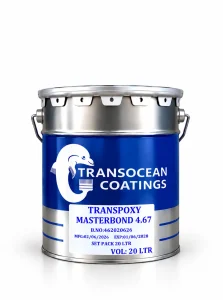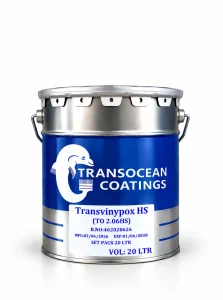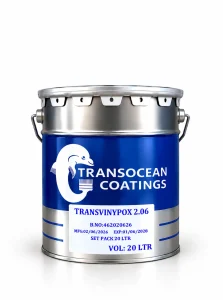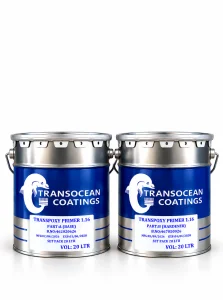


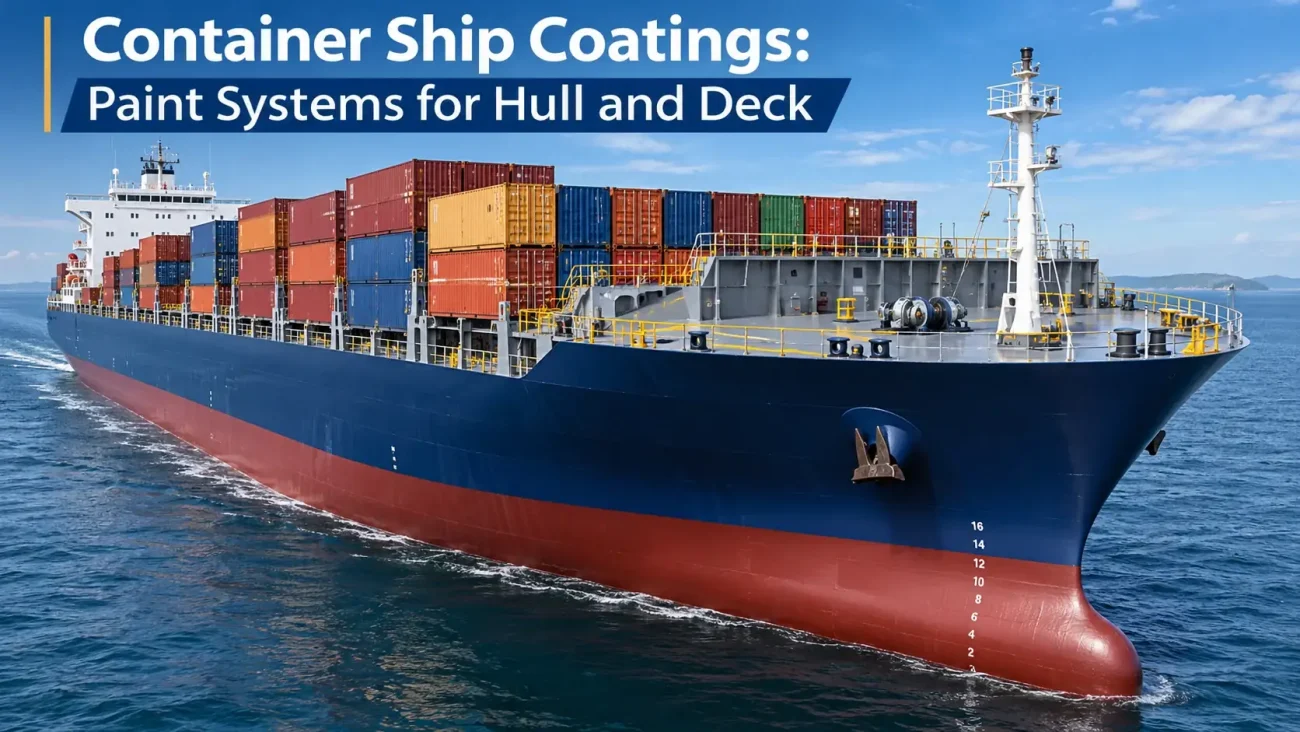
A container ship earns money only when it keeps sailing and keeps turning around fast in port. Rust on the deck or a fouled hull works against both. Well-chosen container ship coatings protect the steel, hold fuel use down and shorten the repair list at the next survey.
This guide is for shipowners and superintendents of box vessels calling at Jebel Ali, Sohar and Duqm. We walk the ship area by area, from the underwater hull to the lashing bridges, explain the primer, midcoat and topcoat logic, and list what to ask a supplier before you order.
Why container ship coatings need a zone-by-zone plan
A container vessel is not painted like a tanker or a bulk carrier. It has a very large hull area, a long weather deck and a cargo that is lashed and unlashed at every port. Container ship coatings must handle all of this at once.
Four things shape the plan for container ship coatings:
- Fast turnaround. Time at the berth is short, so repairs at sea and at anchor must be simple and quick.
- Lashing contact. Twistlocks, lashing bars and corner castings rub the paint on every call.
- Heat and sun. Gulf and Omani summers punish the topsides and the deck with strong UV and high humidity.
- Warm water. Fouling grows fast in Gulf water, so the underwater hull cannot be neglected.
For the bigger picture of how coats work together, read our guide to the marine coating system.
Primer, midcoat and topcoat: the logic behind container ship coatings
Container ship coatings in almost every zone follow the same three-layer logic. Each layer has a job, and the system works only when all three do theirs.
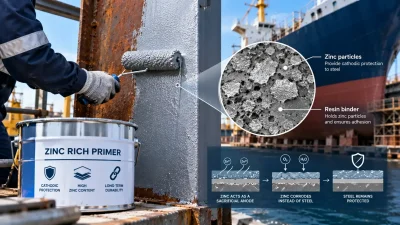
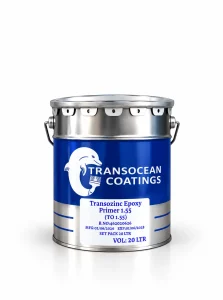
- Primer. It bonds to the prepared steel and gives the first corrosion barrier. Epoxy primers are common; zinc-rich primers suit some areas.
- Midcoat. It builds film thickness, which is the main barrier against water and salt.
- Topcoat. It faces sun, weather and wear. On the hull it is antifouling; on the topsides it is a gloss finish.
Surface preparation sits under all three. A perfect system on a poor surface fails early. Specify the cleaning grade, check the dew point and measure the dry film thickness (DFT) on every coat. Our guide to marine coating DFT explains how it is specified and checked.
Underwater hull: anticorrosive barrier and antifouling
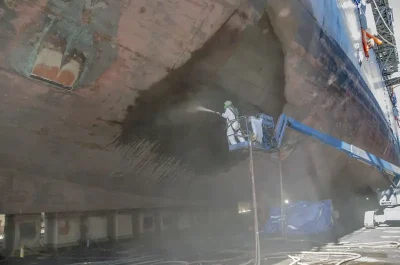
The flat bottom and sides below the waterline are the largest area on a box ship. They need an anticorrosive epoxy barrier first, then the antifouling topcoat.
The antifouling you choose for your container ship coatings depends on speed, idle time and trading route. A vessel on a fast liner service has different needs from one that waits at anchor off Jebel Ali. Our guide to antifouling paint types compares self-polishing and hard matrix products.
Tell the supplier the real service speed, the number of idle days and the dry-docking interval. Do not guess. A wrong antifouling choice costs fuel long before it shows on the hull.
Boot top: the wet-and-dry band
The boot top is the band that moves in and out of the water as the ship loads and unloads. It sees wet and dry cycles, sun, salt spray and contact with tugs and fenders.
In container ship coatings, this zone needs a tough epoxy system with good resistance to both immersion and weather. It also needs antifouling compatibility, because the band carries the edge of the underwater system. Check the overcoating interval between the boot-top coat and the antifouling so the layers bond well.
Damage here is common after berthing. Inspect the band at each port call and repair scratches before rust spreads under the film.
Topsides: a UV-stable finish for the Gulf sun
The topsides are what everyone sees. They also take the full force of the Gulf sun. Ordinary epoxy chalks and fades in strong sunlight, so the finish must be a UV-stable product.
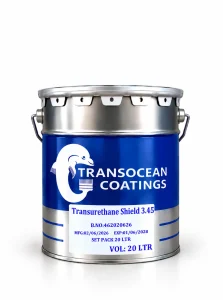
The usual build is an epoxy primer and midcoat, then a polyurethane or similar finish for gloss and colour retention. Our guides to marine topcoats and finishes and marine epoxy vs polyurethane explain why the two chemistries work as a pair and not as substitutes.
Hull names, draught marks and company colours are also part of this system. Mask them well and use compatible paints so touch-ups blend in.
Weather deck and hatch covers: container ship paint for heavy duty
The weather deck and hatch covers carry the heaviest load. Boxes sit on them, crews walk on them, and lashing gear drags across them. This is where hatch cover paint and deck coatings earn their cost.
A strong deck system usually has these parts:
- An anticorrosive epoxy primer on well-prepared steel.
- A high-build epoxy midcoat for film thickness and impact resistance.
- A UV-stable finish where colour matters, or a wear-resistant epoxy finish where traffic is heavy.
Watch the edges, welds, coamings and corners. Paint thins on sharp edges, and rust starts there first. Apply a stripe coat on these points before the full coat.
Lashing bridges and lashing area corrosion: a 5-step control plan
Lashing area corrosion is the number one deck problem on container vessels. The cause is simple: moving steel on painted steel.
Every time a box is lashed, bars and twistlocks scrape the film. Salt and humidity then reach bare metal, and rust grows under the surrounding coat. Left alone, it spreads across the lashing bridges, the cell guide tops and the hatch cover seats.
To keep container ship coatings intact in this area:
- Specify extra film thickness on lashing contact points.
- Choose a tougher, abrasion-resistant epoxy in these areas.
- Inspect after every loading cycle and mark damaged spots.
- Touch up quickly with a compatible product, before rust spreads.
- Keep a record of repairs so the next dry-docking can plan the full recoat.
You can also check coating adhesion on site with a pull-off method such as ASTM D4541.
Application tips for Jebel Ali, Sohar and Duqm
Application conditions in the UAE and Oman are hard. Steel gets very hot in summer, and humidity can be high near the coast. Both affect how paint dries and bonds.
- Steel temperature. Hot steel makes paint dry too fast and can cause dry spray. Paint early or late in the day when possible.
- Humidity and dew point. Keep the steel above the dew point, or moisture is trapped under the coat.
- Dust and salt. Wash salt off before recoating and blow the dust away.
- Cure time. Confirm cure and overcoating times at Gulf temperatures with the supplier.
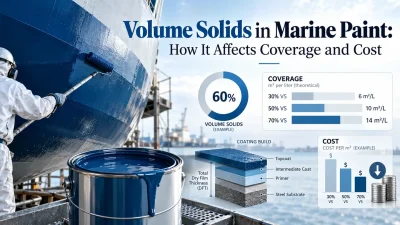
For repair planning at Duqm, the ship repair coatings in Duqm guide covers dry dock paint planning. To plan quantities, use our marine paint consumption guide.
What to ask a supplier before you buy container ship coatings
A clear question list protects you from vague quotes. Before you order container ship coatings, ask the supplier for these items:
- The full system for each zone: primer, midcoat and topcoat.
- Technical data sheets and the target DFT per coat.
- The required surface preparation grade.
- Overcoating intervals and cure time at your local temperature.
- Compatibility with the existing paint, if you are recoating.
- Delivery lead time to Jebel Ali, Sohar or Duqm.
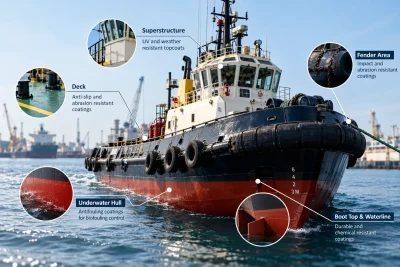
Tugs and workboats have a different duty. If you also manage them, see our tugboat paint system guide. For background on box ships themselves, see this overview of the container ship and its design.
Frequently asked questions
What are container ship coatings?
Container ship coatings are the layered paint systems that protect a box ship’s steel. They include an anticorrosive primer, build coats and a finish, chosen for each zone: underwater hull, boot top, topsides, weather deck, hatch covers and lashing bridges. Each zone has its own exposure, so each gets its own system.
Which paint is used on the deck and hatch covers of a container ship?
Decks and hatch covers normally take an anticorrosive epoxy primer and a high-build epoxy, often finished with a UV-stable polyurethane where colour and gloss matter. Wear-prone lashing areas need extra film thickness. Your supplier should confirm the exact products and the target DFT for the area.
Why does the lashing area corrode so fast?
Lashing bars, twistlocks and container corners rub the paint every time boxes are loaded, lashed and moved. Once the film is broken, salt water and humidity reach bare steel. Rust then creeps under the coat. A thicker, tougher film and quick touch-up after each voyage slow this damage.
How long do container ship coatings last?
There is no single figure. Life depends on surface preparation, applied film thickness, the system used, trading pattern and how fast damage is repaired. Antifouling life is stated on its data sheet. Plan repainting around class surveys and dry-dockings, and inspect the deck and lashing areas every year.
Can one paint be used for the whole container ship?
No. The underwater hull needs an anticorrosive system plus antifouling, the topsides need a UV-stable finish, and the deck needs a tough, wear-resistant system. A single product cannot meet all of these demands. Use a complete system where every coat is compatible with the one below it.
What should I ask a marine paint supplier before ordering?
Ask for the full system per zone, the data sheets, the target DFT, the surface preparation standard, the overcoating intervals and the cure time at Gulf temperatures. Ask also about technical support at the berth or yard and how quickly the supplier can deliver to Jebel Ali, Sohar or Duqm.
Get a coating plan for your container ship
Planning a repaint or a newbuild paint package for a box vessel in the UAE or Oman? Request a quote for TransOcean marine paints and tell us the zones, the area and the target DFT. Our team will send the data sheets so you can match each layer to the hull, deck and lashing area. For other questions, contact us.