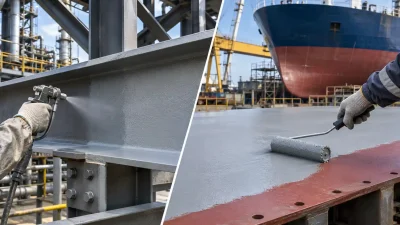



A ship deck takes more punishment than almost any other surface on the vessel. Sun heats it, salt water soaks it, cargo gear scrapes it and crew walk on it every day. If the paint fails, rust starts under the film, and the repair gets expensive. A well-planned ship deck coating system prevents most of this.
This guide is for superintendents, yard managers and buyers in the UAE and Oman. It explains the layers of a deck system, how to choose the topcoat, how to prepare steel and check film thickness, and how to maintain the deck over the years.
What is a ship deck coating system?
A ship deck coating system is more than one can of paint. It is a sequence of coats, each with a different task, applied on steel that has been cleaned and profiled. In general, the layers work like this:
- Primer: bonds to the steel and starts the corrosion protection.
- Intermediate coat: builds the film thickness and acts as a barrier against water and salt.
- Topcoat: resists sunlight, weather and wear, and gives the final colour.
- Non-slip areas: add grip where crew walk and work.
Our guide to the marine coating system explains the same primer, midcoat and topcoat logic for the whole vessel. This article applies it to the deck. If your main question is anti-slip finishes, read our separate guide on non-skid deck paint for ships.
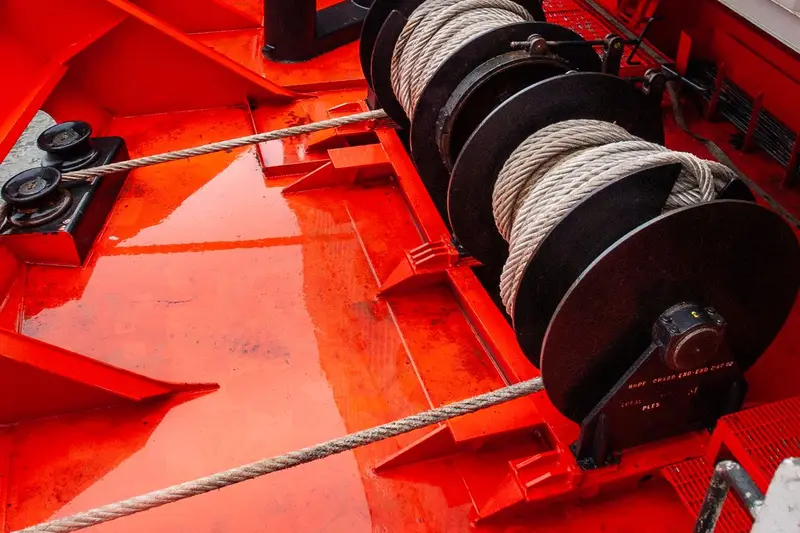
What a ship deck coating system must withstand
Before you select any product, list what the deck has to survive. A ship deck coating system must handle several loads at once:
- Abrasion: foot traffic, wires, hatch covers, trolleys and dropped tools.
- UV and heat: in the Gulf, the sun can degrade a weak topcoat quickly.
- Salt water: spray and washing keep the deck wet and salty.
- Chemicals and oil: fuel, hydraulic oil and cleaning agents.
- Slip risk: a wet painted deck can be dangerous without grip.
No coating is perfect for every load. The usual answer is a combination: epoxy for strength and barrier protection, polyurethane for sun resistance. Our guide to marine epoxy vs polyurethane coatings compares the two in detail.
The 5 steps of a ship deck coating system
Here is the sequence in short form. Each step is explained below.
- Prepare the steel to the specified cleanliness and profile.
- Apply the primer before the surface can flash rust.
- Build the film with the intermediate coat.
- Add non-slip in the areas that need grip.
- Finish with a polyurethane topcoat and verify the thickness.
Step 1: Prepare the steel deck
Most early failures come from poor preparation, not from poor paint. Remove oil, grease, salt and loose rust. Then blast or mechanically clean the steel to the grade in the specification. ISO 8501-1 defines the visual grades of cleanliness for blasted steel, and the paint maker states which grade the primer needs.
Decks often have corners, welds, drains and fittings that are hard to reach. Treat them carefully, because edges and welds are where coatings fail first. Our guide to marine coating surface preparation covers standards and methods, and the article on blasting abrasives for ships helps you choose the abrasive.
Check the weather too. Do not paint when the steel is wet or close to the dew point. Salt left on the steel causes blisters later, so wash and dry the deck before coating.
Step 2: Apply the epoxy primer
Apply the primer, the first coat of the ship deck coating system, as soon as the steel is clean and dry. Bare blasted steel starts to rust fast in humid coastal air. A primer for a deck is usually an epoxy type. Where the specification calls for it, a zinc-rich primer gives additional protection. For the difference, read our comparison of zinc silicate vs zinc epoxy primer.
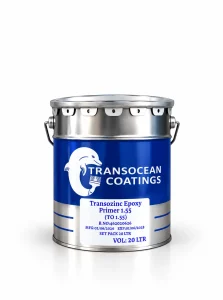
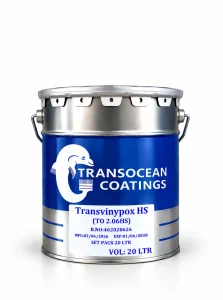
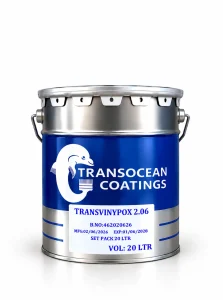
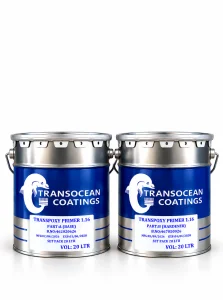
In the TransOcean range, the Transpoxy Primer A&B (TO 1.16) is a two-component epoxy primer, and the Transozinc Epoxy Primer 155 (TO 1.55) is a zinc epoxy primer. Pick the one that matches your specification, and read its data sheet for the thickness, mixing ratio and overcoat interval.
Respect the overcoat window. If you leave an epoxy too long before the next coat, the surface can become hard to bond. If you coat too soon, solvent can be trapped. The data sheet gives the limits for the temperature on site.
Step 3: Build film with the epoxy intermediate coat
In a ship deck coating system, the intermediate coat adds film thickness and makes the barrier against water and salt. On a deck, this layer is usually a high-build epoxy. Thicker films resist impact and abrasion better, so do not skip this step to save time.
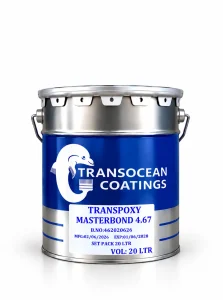
For a high-build epoxy in the same range, see the Transpoxy Masterbond BT (TO 4.68). As always, confirm the use on a deck, the thickness and the recoat times on the data sheet before you order.
Apply the coat evenly, with attention to edges and welds. Many crews use a stripe coat on edges, bolts and weld seams before the full coat. This extra pass protects the places where paint tends to pull thin.
Step 4: Add non-slip where the crew walk
In a ship deck coating system, grip is not needed everywhere, but it is needed in the right places. Walkways, ladders, stair landings, hatch tops and work areas need an anti-slip surface. Ask three questions: who walks here, is the area often wet or oily, and does the class or the owner require a non-slip finish?
There are several methods: aggregate mixed into the paint, grit broadcast into a wet coat, or ready-made textured coatings. Each has different grip, cleaning and repair characteristics. Our full guide to non-skid deck paint compares them.
Plan the non-slip areas before painting starts. Mask the edges, so the lines are clean, and make sure the grit is covered by the topcoat according to the system specification.
Step 5: Finish with a polyurethane topcoat
A deck is in the sun all day, so the topcoat of a ship deck coating system decides how the deck looks and ages. Polyurethane topcoats are widely chosen here because they keep colour and gloss under UV better than most epoxies. Our guide to marine topcoats and finishes helps you pick a polyurethane finish.
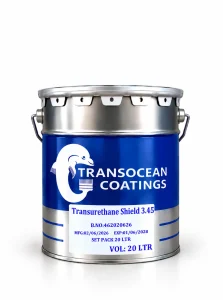
For deck use, review the Transurethane Finish (TO 3.43) and the Transothane Finish Base (TO 3.63). These are two-component polyurethane finishes from the TransOcean range. Check the data sheet for the colours, the thickness and the overcoat time.
When you choose the colour, remember that dark colours get hotter in the sun. Light colours reflect more heat. Your owner or class may also set colour rules for safety areas.
Check film thickness on every coat
Your deck coating system only works if each coat reaches the specified thickness. Too thin, and the steel is protected less. Too thick, and the film may crack or trap solvent. Control it in two stages.
- Wet film: check it while you paint, so you can correct the coat immediately. See our guide to wet film thickness.
- Dry film: measure it after cure with a calibrated gauge and record the values. Our guide to marine coating DFT explains the inspection.
Also record the weather, the surface temperature, the batch numbers and the times between coats. These records help if a claim or a repair comes later.
Deck coating maintenance and repair
Even a good ship deck coating system needs attention. Walk the deck regularly and look for chips, rust bleeding, soft spots, worn walkways and fading. Wash the deck with fresh water to remove salt. Avoid harsh cleaners, and use only what the paint maker allows.
Repair small damage early. Clean the spot, remove loose rust, feather the edges, and apply the primer and topcoat according to the system. Our guide on spot repair vs full recoat explains how to decide when a patch is enough.
Different vessels also have different deck demands. See our notes on container ship coatings and the tugboat paint system for examples.
Common mistakes with deck paint on ships
These mistakes spoil a ship deck coating system again and again:
- Weak preparation. Paint over salt, oil or loose rust will not last.
- Epoxy as the only coat in the sun. The surface chalks and loses colour.
- Missing the overcoat window. This causes poor adhesion between coats.
- No stripe coat. Edges and welds fail first.
- Non-slip on the wrong areas. Grit everywhere makes cleaning hard, and no grit on walkways is unsafe.
- No thickness records. You cannot prove or repair what you did not measure.
- Painting in poor weather. Damp steel and high humidity cause blisters.
Frequently asked questions
What is a ship deck coating system?
A ship deck coating system is a set of paint layers applied in order on a prepared steel deck. It usually has an epoxy primer, an epoxy intermediate coat and a polyurethane topcoat, with non-slip areas where crew walk. Each layer has a job: protect the steel, build film thickness, or resist sun and wear.
Which paint is best for a ship deck?
No single paint fits every deck. Epoxy gives strong adhesion and abrasion resistance, so it is used for primer and intermediate coats. Polyurethane resists sunlight and keeps colour, so it is used as the topcoat. Choose the exact products from the project specification and the technical data sheets.
Why not use epoxy alone as the topcoat?
Many epoxies chalk and lose gloss under strong sunlight, which is common in the Gulf. The coating may still protect the steel, but the deck looks worn early. A polyurethane topcoat keeps colour and gloss better, so it is usually placed over the epoxy where the deck is exposed to sun.
How thick should deck paint be?
The thickness comes from the coating specification and the paint maker’s data sheet, not from a general rule. Each coat has a target dry film thickness, and the whole system has a total. Measure the wet film while painting and the dry film after cure, then record the readings.
Do I need non-slip paint on the whole deck?
No. Non-slip is needed where people walk and work, such as walkways, stairs, hatch tops and working areas. Wide areas of the deck can keep a smooth topcoat that is easier to clean. The ship’s rules, class requirements and your safety plan decide which areas need it.
How often should a ship deck be recoated?
There is no fixed interval. It depends on wear, sun, cargo handling and the first system. Inspect the deck regularly, and touch up chips, rust spots and worn walkways early. Spot repairs are cheaper than a full recoat. Plan a full recoat when the damage is widespread or the topcoat has failed.
Get a quote for deck epoxy and polyurethane paint
Planning a deck repaint or a new ship deck coating system? Review the TransOcean marine paint range and request a quote there. Send us the vessel type, the deck area, the current coating and the site, and we will help you match the primer, intermediate coat and polyurethane topcoat to your specification.